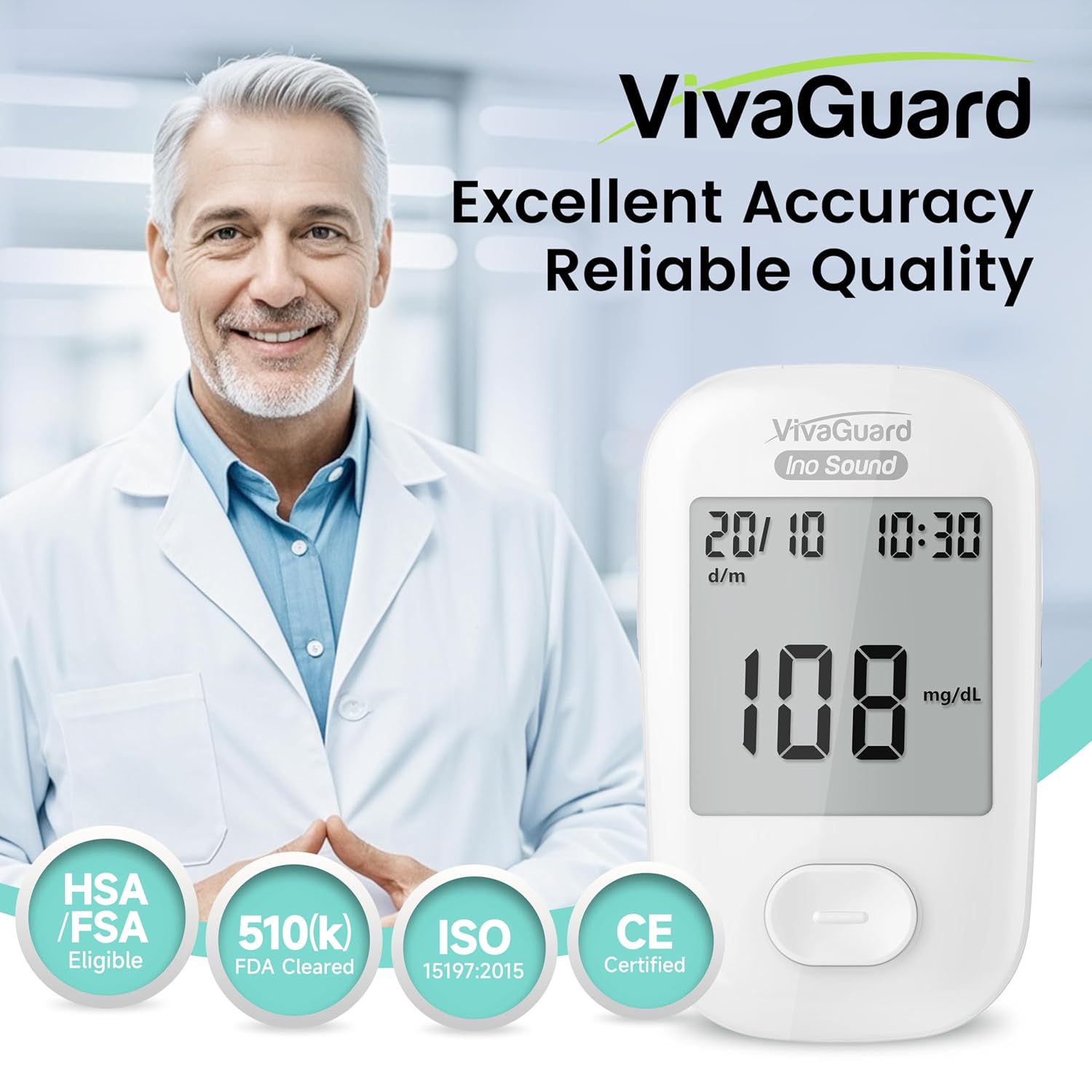
Managing blood sugar (the amount of glucose circulating in your bloodstream) requires reading small numbers off a tiny screen — sometimes multiple times a day. For anyone with vision loss, shaky hands, or aging eyes, that routine can quietly become a safety hazard. A talking glucose meter solves the problem directly: the device reads your result aloud after every test, so you don’t have to squint or guess. These aren’t niche gadgets. They’re FDA-cleared, widely available, and — critically — covered by Medicare in most cases. If you’re a diabetes educator, caregiver, or clinician steering a patient toward better self-monitoring, this guide breaks down the real options: what each meter does well, where it falls short, what the strips actually cost per month, and how to make the final call.
| EDITOR'S PICKVivaGuard Talking Blood Glucose… | Mid-tierMedline EvenCare G2 Blood Gluco… | Budget pickMedline EvenCare G2 Blood Gluco… | |
|---|---|---|---|
| Voice guidance | ✓ | — | ✓ |
| Strips included | 100 | — | — |
| Lancets included | 100 | — | — |
| Result time | — | 6 sec | 6 sec |
| Memory | 1000 | — | — |
| Price | $26.98 | $21.59 | $14.16 |
| See on Amazon → | See on Amazon → | See on Amazon → |
Why Voice Guidance Matters More Than You Might Expect
Diabetic retinopathy — the damage high blood sugar causes to the tiny blood vessels in the eye — affects roughly one in three adults with diabetes, per the National Eye Institute’s diabetic retinopathy resource. That’s not a rare edge case. Add in the normal contrast-sensitivity loss that comes with aging, cataracts, or glaucoma, and you have a massive population of users for whom a standard 12-point LCD readout is genuinely inadequate.
The clinical consequence is real. Misread results lead to incorrect insulin dosing decisions. The American Diabetes Association’s Standards of Care in Diabetes 2025 explicitly emphasizes that monitoring tools must match the patient’s functional ability — not just their clinical profile. A meter that technically reads accurately but can’t be reliably read by the patient fails the practical standard of care.
Beyond accuracy, there’s the independence argument. Caregivers and family members cannot always be present for every test. A talking meter gives a low-vision user the ability to test alone, correctly, at 2 a.m. That’s not a convenience feature — it’s a meaningful quality-of-life and safety outcome.
The Shortlist: Talking Meters Worth Recommending
Prodigy Voice Blood Glucose Meter
The Prodigy Voice is the most widely cited talking meter in the U.S. market, and for good reason. It announces results in English and Spanish, reads menu instructions aloud, and includes a large-button design that works well for users with limited dexterity. The American Foundation for the Blind has historically listed it in accessible diabetes product resources, and Healthline’s review of glucose meters for seniors consistently ranks it as a primary recommendation for low-vision users.
Strip economics matter here. Prodigy’s No-Code test strips are sold through major pharmacy chains and Amazon, and per published retail pricing as of mid-2026, a box of 50 strips runs approximately $18–$22. At two tests per day, that’s roughly $22–$26/month — solidly mid-range. Medicare Part B covers Prodigy Voice meters and compatible strips under the durable medical equipment (DME) benefit; beneficiaries typically pay 20% after the Part B deductible when purchased through a Medicare-enrolled supplier.
FSA/HSA eligible? Yes. The meter and strips both qualify as medical devices under IRS Publication 502.
The tradeoff: The Prodigy Voice is not a Bluetooth-connected meter. There’s no companion app, no data syncing to a phone. For patients or caregivers who want trend data without a CGM, that’s a meaningful gap. It’s the right tool for independent testing with spoken feedback; it’s not a data-management platform.
Clever Choice Voice Talking Glucose Meter
The Clever Choice Voice is another strong option, notable for its aggressive retail pricing. Published street prices run around $15–$20 for the meter itself, with strips available in larger bulk packs that push the cost-per-strip lower than Prodigy’s for high-frequency testers.
Across aggregated pharmacy and retail reviews, owners consistently report that the voice function is clear, the volume is adjustable, and the interface is simpler than competing meters — which matters when the user population may also be dealing with cognitive load or early dementia alongside vision loss.
The tradeoff: Clever Choice has less brand recognition in clinical settings, which can complicate prior authorization conversations with insurers outside Medicare. If a caregiver is navigating a commercial insurer’s DME formulary, Prodigy’s broader clinical footprint often makes the paperwork easier.
iGlucose / Talking Meter with Cellular Auto-Reporting
A subset of the market — smaller but growing — combines voice readout with automatic cellular transmission of results to a caregiver or care team. The iGlucose system (distributed through Spirit Medical) reads results aloud and simultaneously sends readings to a secure cloud dashboard accessible to family or clinicians, without requiring the patient to own or operate a smartphone.
This is a fundamentally different value proposition. The clinical use case isn’t just “I can hear my number” — it’s “my daughter in another city knows my number too.” For aging parents living alone with poorly controlled diabetes, that passive reporting loop is a meaningful safety net.
Strip economics: iGlucose strips run higher — roughly $30–$40 per 50 strips at retail in mid-2026 — and the cellular service adds a monthly subscription (~$20–$30/month depending on plan). Total cost of ownership is meaningfully higher.
Medicare / insurance note: Cellular transmission services are not covered under standard Medicare Part B DME benefits. The meter hardware and strips may qualify separately, but families should budget the connectivity fee as an out-of-pocket line item. Per Medicare.gov’s diabetes supplies coverage page, Part B covers meters and strips but does not cover monitoring software subscriptions or cellular data plans.
FSA/HSA eligible? The meter and strips: yes. The cellular subscription: no — it falls outside IRS Publication 502’s definition of a qualifying medical expense.
By the Numbers
| Meter | ~Strip Cost / 50 ct | Tests/Day (avg) | Est. Monthly Strip Cost | Medicare Part B Covered? | FSA/HSA Eligible? |
|---|---|---|---|---|---|
| Prodigy Voice | $18–$22 | 2 | ~$22–$26 | Yes (enrolled supplier) | Yes |
| Clever Choice Voice | $14–$18 | 2 | ~$17–$22 | Formulary-dependent | Yes |
| iGlucose (w/ cellular) | $30–$40 + ~$25 service | 2 | ~$45–$65 total | Partial (strips only) | Partial (strips only) |
Prices reflect mid-2026 retail. Medicare reimbursement rates vary by supplier and region.
Where CGMs Fit (and Where They Don’t)
A reasonable question at this point: if a patient already struggles with a traditional meter, should they skip meters entirely and move to a continuous glucose monitor (CGM) — a small sensor worn on the body that tracks glucose automatically every few minutes?
The honest answer is: sometimes yes, but not always.
CGMs like the Abbott FreeStyle Libre 3 and Dexcom G7 eliminate the need for routine fingerstick testing, which removes the small-screen readout problem entirely for daily monitoring. Both systems integrate with smartphones and display large, readable numbers. The Dexcom G7 also triggers audible and vibration alarms for high and low glucose — a safety feature with real clinical weight for low-vision users who can’t easily see the graph.
The tradeoffs for this population:
- CGMs require sensor application every 10–15 days, which involves peeling adhesive backing, pressing a small applicator against the skin, and occasionally troubleshooting sensor adhesion issues — a known pain point in online patient communities and a real barrier for users with severe vision impairment or limited hand function.
- Medicare covers CGMs for Type 1 patients and for insulin-dependent Type 2 patients who meet clinical criteria. Coverage for non-insulin-using Type 2 patients expanded in 2025 but remains subject to prior authorization. Cash-pay cost for Libre 3 sensors runs approximately $75–$90 per two-sensor pack (roughly 28 days of coverage) without insurance.
- CGMs don’t replace fingerstick meters for calibration confirmations in certain clinical situations. A talking fingerstick meter remains a valid backup even for CGM users.
Bottom line for practitioners: for a low-vision patient on insulin, a CGM plus a talking backup meter is the gold-standard combination. For a low-vision patient managing Type 2 with diet and oral medications, a talking meter alone may be entirely sufficient — and dramatically more affordable.
The Decision Frame: If X, Then Y
Here’s how to route the recommendation based on the patient profile in front of you:
If the patient is low-vision, independent, non-insulin-using Type 2, and on a fixed income → Prodigy Voice or Clever Choice Voice. Confirm Medicare Part B enrollment through a qualifying supplier, run the 20% copay math against their income, and flag FSA/HSA eligibility for employed caregivers purchasing on their behalf.
If the patient is low-vision, living alone, and the family has remote-monitoring anxiety → iGlucose with cellular reporting. Budget the service fee explicitly in the conversation so cost doesn’t cause mid-month abandonment. Clarify to the family that the cellular subscription is not FSA/HSA reimbursable.
If the patient is insulin-dependent with significant vision loss → Lead with a CGM referral (Libre 3 or Dexcom G7 depending on payer coverage) and pair it with a Prodigy Voice as a backup/confirmation meter. Document CGM medical necessity with the required clinical criteria to support Medicare or commercial prior authorization.
If the patient has both vision loss and significant dexterity issues → The sensor-application process for CGMs deserves explicit discussion before recommending one. A talking meter with large buttons (Prodigy Voice’s form factor is consistently noted by occupational therapists as easier to grip) may reduce errors compared to the fine motor demands of sensor placement.
The core principle, per the ADA’s 2025 Standards of Care, is that technology choice should follow the patient’s actual functional capacity — not just their clinical diagnosis. A talking meter isn’t a consolation prize for patients who “can’t handle” a CGM. It’s the right tool when it matches the user’s real-world situation, and recommending it clearly — with the insurance math done and the monthly cost spelled out — is exactly the kind of decision-enabling guidance that turns a patient’s confusion into a confident purchase.