If you’re newly diagnosed with diabetes — or if someone in your life is — the phrase “diabetic socks” might sound like medical overkill. They’re just socks, right? Not quite. Diabetic socks are specifically engineered without the elastic cuff that circles the top of a standard sock. That tight band is what leaves a red ring on your leg after a long day, and for people with diabetes, that compression can restrict blood flow to feet that already have reduced circulation. Diabetic neuropathy — nerve damage in the feet that affects a significant portion of people with long-term diabetes, according to the Mayo Clinic’s overview of diabetic neuropathy symptoms and causes (mayoclinic.org) — means foot injuries can go unnoticed for dangerously long periods. A sock that cuts off circulation, creates friction, or bunches inside a shoe becomes a genuine risk, not just a comfort nuisance. This article breaks down four popular non-binding sock styles — bamboo viscose, standard knit, and crew cuts — so you can match the right sock to the right foot situation.
Here’s what makes this comparison interesting: the people leaving the most enthusiastic reviews for these socks aren’t always diabetic. People managing lymphedema, thick ankles, weight-related swelling, and leg fatigue from standing jobs are buying these in bulk and describing them as a revelation. That overlap tells you something important about what these socks actually do well — and where their real limits are.
| EDITOR'S PICK[Special Essentials Diabetic Soc…](https://www.amazon.com/dp/B08KWLL3BQ?tag=greenflower20-20) | Mid-tier[Doctor's Select® Diabetic Socks…](https://www.amazon.com/dp/B0FHBCD9TD?tag=greenflower20-20) | Budget pick[Revosoxs Diabetic Crew Socks fo…](https://www.amazon.com/dp/B0DHTP8SC3?tag=greenflower20-20) | |
|---|---|---|---|
| Pairs | 12 | 4 | — |
| Material | — | — | Bamboo viscose |
| Seamless toe | — | — | ✓ |
| Price | $24.99 | $17.99 | $14.89 |
| See on Amazon → | See on Amazon → | See on Amazon → |
What “Non-Binding” Actually Means — and Why the Cuff Is Everything
The defining feature of a diabetic sock isn’t what’s in it. It’s what’s not in it: the tight elastic band at the top.
Standard socks use an elasticized cuff to stay up. That cuff generates circumferential pressure — enough to leave visible indentation marks on the lower leg after a few hours. For most people, that’s a minor annoyance. For someone with peripheral vascular disease, venous insufficiency, or diabetes-related circulation changes, that pressure can impede blood return from the foot, worsen edema, and in worst cases contribute to skin breakdown.
The American Diabetes Association’s Standards of Medical Care in Diabetes 2025, Section 12: Retinopathy, Neuropathy, and Foot Care (published in Diabetes Care, available at diabetesjournals.org) specifically flags foot protection and daily inspection as cornerstones of diabetes management, noting that peripheral neuropathy dramatically raises the stakes for any chronic foot irritant. A sock that doesn’t bite at the cuff is a small intervention with meaningful compounding effect.
Non-binding socks solve the stay-up problem differently. They use a wider, softer cuff made of looser-knit fabric or a blend that grips by surface area rather than elastic tension. The tradeoff — and it’s a real one — is that they can slip down in some footwear. More on that below.
The Four Styles Worth Comparing
Special Essentials Non-Binding Crew Socks
Revosoxs
$14.89
In stock on Amazon
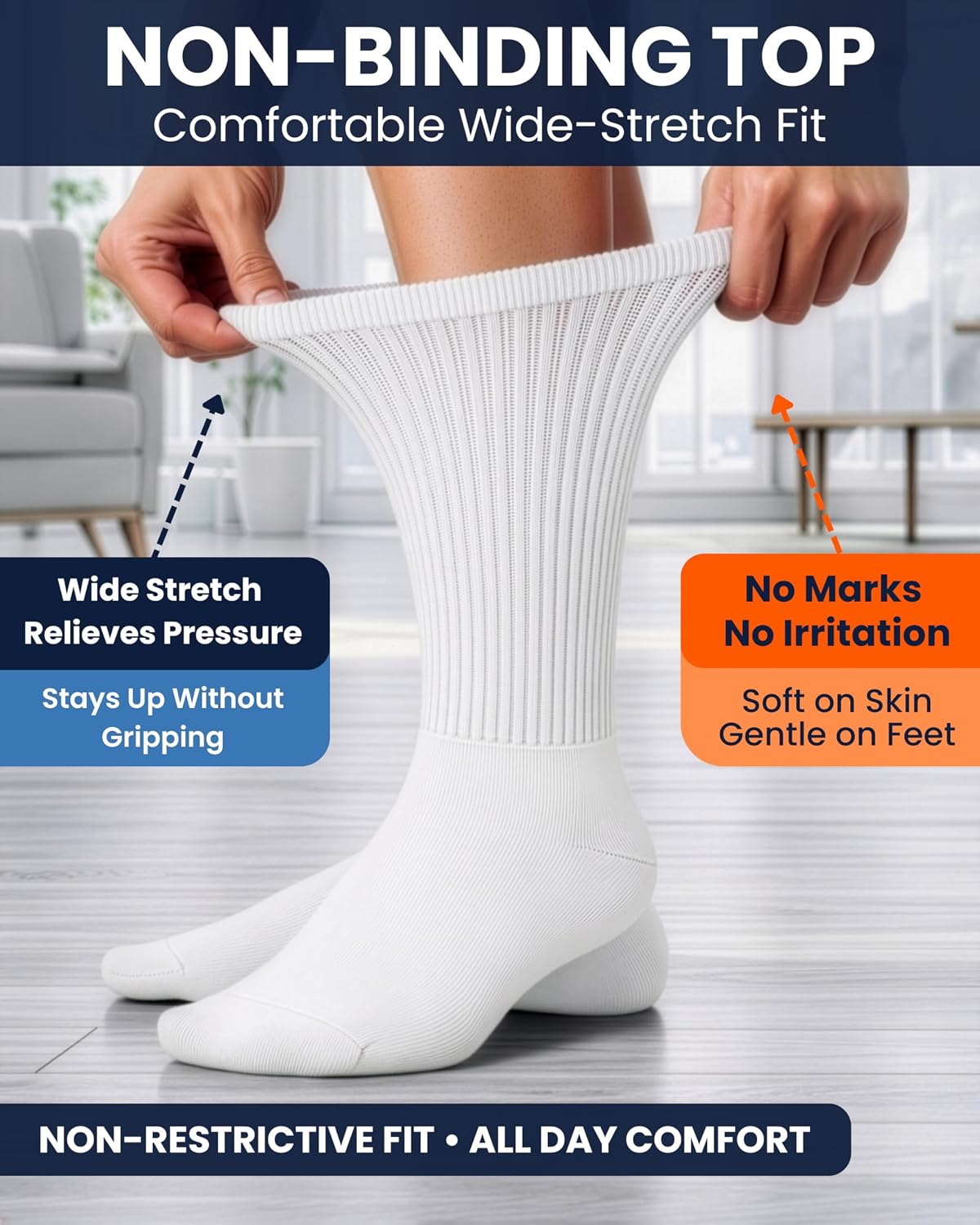
Check price on AmazonOwners with thick ankles consistently flag this one as a game-changer. In aggregated owner reviews, the pattern that emerges most often is a comparison to standard socks worn above the ankle: reviewers describe standard cuffs as “way too tight,” with Special Essentials filling a gap that most sock brands simply don’t address.
The crew-cut construction means the cuff sits higher on the ankle than a low-cut diabetic sock, which gives more coverage without adding compression. Owners managing lymphedema and weight-related ankle swelling mention that the fit feels loose without feeling sloppy — a specific fit register that’s harder to achieve than it sounds. The crew height also contributes to the most consistent “stays up” reports among the four styles reviewed here, because a taller cuff has more surface-area contact with the leg.
The tradeoff: owners in very low-cut athletic shoes report some cuff visibility above the shoe line, which is a style concern rather than a performance one.
Revosoxs
$14.89
In stock on Amazon
Check price on AmazonPembrook Bamboo Diabetic Socks
Doctor's
$17.99
In stock on Amazon
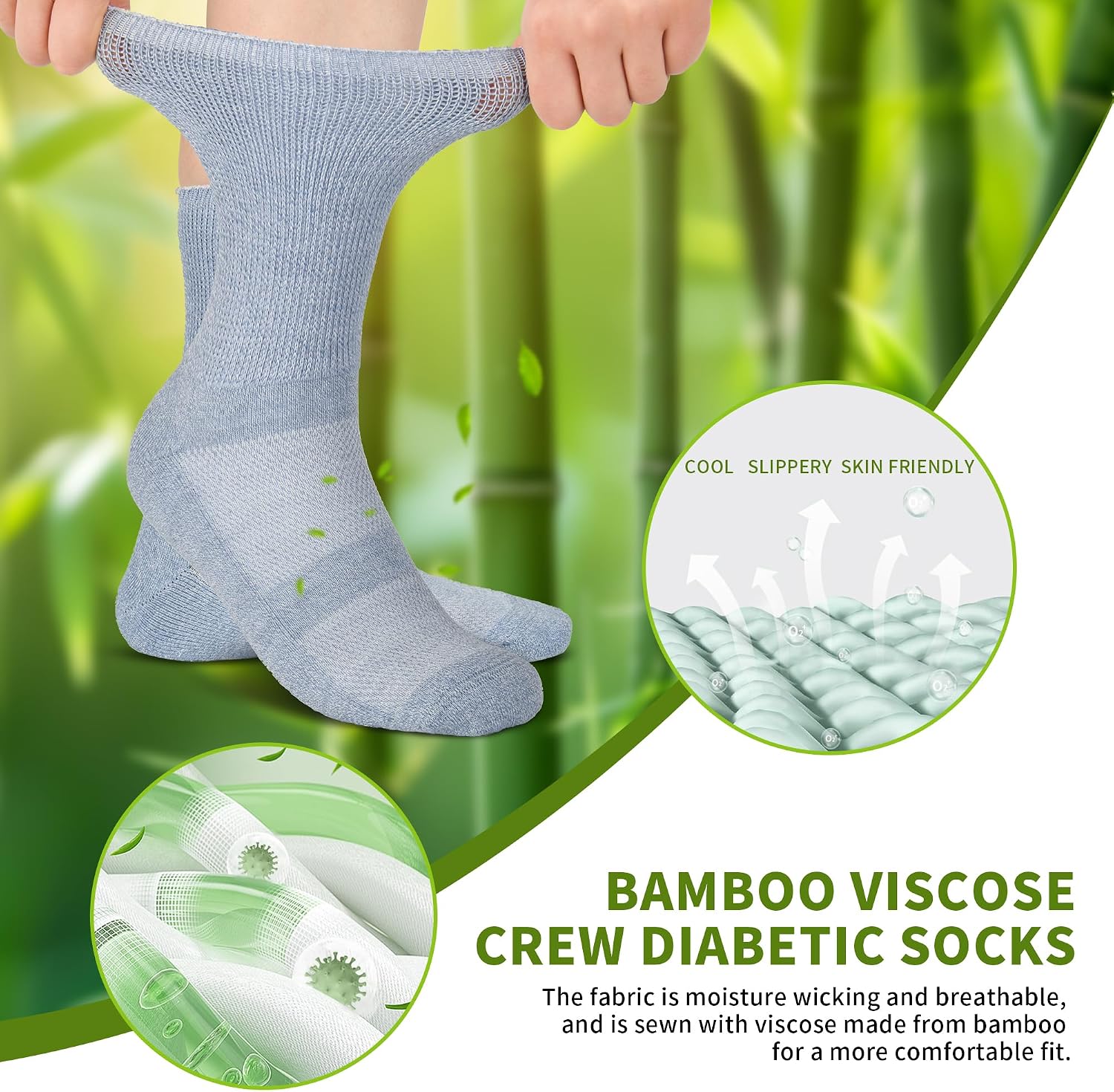
Check price on AmazonBamboo viscose has a specific feel that cotton-knit socks don’t replicate. Research indexed in the NIH National Library of Medicine on PubMed (ncbi.nlm.nih.gov) on bamboo fiber textile properties identifies bamboo viscose as notably moisture-wicking and thermoregulating compared to standard cotton blends. Healthline’s overview of diabetic socks (healthline.com) corroborates that moisture management is among the most clinically relevant sock features for people with diabetes, given that excess moisture between the toes accelerates maceration and raises fungal risk.
What owner reports add that published specs don’t capture: the feel of putting them on. Reviewers who previously wore compression hose describe the relief of a sock they can put on without ripping a fingernail — a specific, visceral complaint that comes up repeatedly. Compression hose require significant pulling force to don correctly, and for anyone with hand arthritis or limited dexterity, that’s a daily friction point. Pembrook owners switching from compression hose report a qualitative shift in morning routine, not just foot comfort.
The tradeoff worth naming: bamboo viscose socks tend to run slightly pricier per pair than equivalent cotton-knit options. If you’re outfitting a full weekly rotation — say, 14 pairs for two weeks between laundry — the cost differential adds up.
Doctor's
$17.99
In stock on Amazon
Check price on AmazonDoctor’s Select Non-Binding Diabetic Socks
Doctor's
$17.99
In stock on Amazon
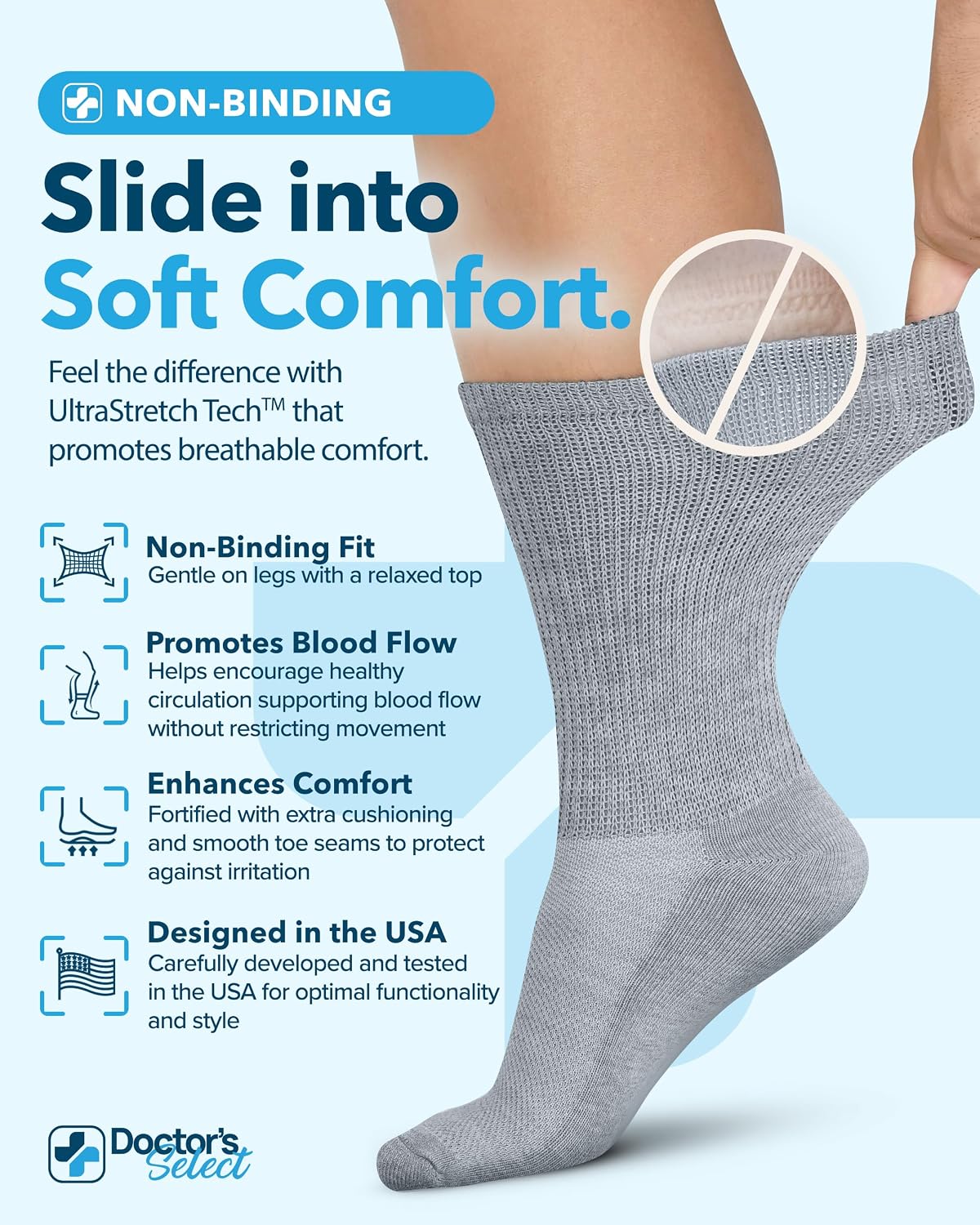
Check price on AmazonAmong the four, Doctor’s Select generates the most consistently specific vocabulary in owner reviews: “no strangulation marks,” “lightweight,” “breathable.” That language is meaningful because it distinguishes this product from bulkier diabetic socks that sacrifice breathability for cushioning.
The value proposition here is the lightweight knit construction. Heavier diabetic socks often incorporate extra heel and toe padding, which is appropriate for neuropathy patients who need impact buffering — but adds bulk that some shoes can’t accommodate and some owners simply find uncomfortable in warm weather. Doctor’s Select reviewers specifically contrast the weight with bulkier alternatives, suggesting a buyer segment that has tried the padded options and found them too hot or too tight in the shoe box.
This reflects a meaningful split in the diabetic sock market: padded-and-protective versus thin-and-breathable. If the primary concern is circulation and binding, thin and breathable often wins. If the primary concern is neuropathic impact protection — numbness combined with walking on hard surfaces — padding earns its bulk.
Doctor's
$17.99
In stock on Amazon
Check price on AmazonRevosox Non-Binding Diabetic Socks
Special
$24.99
In stock on Amazon
Check price on AmazonRevosox generates a qualified endorsement pattern in owner reviews — a real but nuanced signal. Owners note the cuff is “slightly tighter than hoped” while simultaneously rating it as the best non-binding option they’ve found. That pairing — an acknowledged limitation alongside a strong overall recommendation — is more useful than uniformly positive reviews, because it tells you the comparison set these buyers are working from.
The implicit message: Revosox represents the tighter end of the non-binding spectrum. If your feet and ankles are average-sized and you’re coming from standard socks, you may not notice the tension difference. If you’re managing significant ankle edema or have been told by a care team to avoid any leg compression, compare this against the looser cuffs in the Special Essentials or Pembrook options before committing to a full pack.
Special
$24.99
In stock on Amazon
Check price on AmazonQuick-Reference Comparison
| Style | Primary Material | Cuff Feel (Owner Reports) | Best For |
|---|---|---|---|
| Special Essentials Crew | Cotton blend | Loosest; crew height | Thick ankles, lymphedema, wide calves |
| Pembrook Bamboo | Bamboo viscose | Loose; soft drape | Moisture-sensitive feet, compression hose escapees |
| Doctor’s Select | Lightweight knit | Loose-to-medium | Warm weather, tight shoe boxes, breathability priority |
| Revosox | Knit blend | Medium (qualified “slightly tighter”) | Standard ankle size, all-day wear |
Who’s Actually Buying These — and What That Tells You
The non-diabetic buyer cohort is large and growing. Owners managing lymphedema describe standard socks above the ankle as “way too tight” — the same language diabetic buyers use, for the same mechanical reason. People in standing-intensive jobs such as healthcare, retail, and food service are buying diabetic socks for leg fatigue, not blood sugar. Buyers who find standard sock cuffs leave marks regardless of diagnosis are a significant segment.
This matters clinically and practically. If you’re a diabetes educator or care specialist recommending these socks to patient panels, the conversation doesn’t have to be framed around diabetes alone. Anyone with chronic lower-leg swelling, any reason to avoid cuff compression, or any foot that’s been irritated by a sock band is a reasonable candidate.
Healthline’s overview of diabetic socks (healthline.com) notes that features like seamless toe construction, non-binding cuffs, and moisture-wicking fabric represent simply good foot-sock design for any high-risk foot, regardless of diagnosis.
If X, Then Y: The Decision Framework
If ankle swelling is the primary driver — lymphedema, edema, thick calves, or marks from standard socks — prioritize Special Essentials or Pembrook. Both generate the most consistent “finally a sock that fits” language from non-standard-ankle owners.
If you’re switching from compression hose and ease of donning is a concern — Pembrook bamboo is the pattern match. The specific complaint of compression hose requiring excessive pulling force comes up in Pembrook reviews in a way it doesn’t for the other three, and bamboo viscose’s softness makes donning noticeably easier.
If breathability in warm weather or a tight shoe box is the constraint — Doctor’s Select’s lightweight construction earns its category. The “no strangulation marks plus lightweight” combination is a specific fit that padded diabetic socks don’t replicate.
If you’re working with an average ankle circumference and want a confident all-around performer — Revosox’s qualified endorsement is actually a strong signal. Buyers who name a limitation and still call it the best option they’ve found are reliable reviewers.
If you’re a caregiver buying for an aging parent — start with bamboo viscose. The ease-of-donning advantage and moisture management are both high on the clinical relevance list for older feet, and the softness is mentioned consistently in reviews from caregivers buying on behalf of parents.
Frequently Asked Questions
Do these socks really not leave marks on your legs, even with swollen ankles? Based on aggregated owner reports, yes — especially for Special Essentials and Pembrook owners with documented ankle swelling. The “no marks” outcome is the most commonly cited positive across all four products. The caveat is Revosox, where a small subset of owners with significant edema note mild cuff awareness. If marks are your primary concern and your ankles are larger than average, Doctor’s Select and Special Essentials generate the most unqualified “no marks” feedback.
What’s the difference between bamboo viscose and standard cotton diabetic socks? Bamboo viscose is a processed fiber made from bamboo pulp. Research indexed in the NIH National Library of Medicine on PubMed (ncbi.nlm.nih.gov) documents higher moisture-wicking capacity and natural antimicrobial properties in bamboo fiber compared to standard cotton. In practical terms, owners report that bamboo socks feel softer against skin, stay drier during activity, and generate less friction. Cotton diabetic socks are often less expensive per pair and more widely available; bamboo socks carry a modest price premium for those material properties.
Can people without diabetes wear diabetic socks for comfort or swelling? Absolutely, and they do — in large numbers. Buyers managing lymphedema, obesity-related swelling, standing-job fatigue, and varicose veins are purchasing all four products reviewed here. There is no clinical reason a non-binding, moisture-wicking sock with a seamless toe is limited to diabetic wearers. The features represent good foot-sock design for anyone whose feet or ankles experience pressure, swelling, or irritation.
Do non-binding socks stay up, or do they fall down constantly? This is the real tradeoff, and it’s worth being honest about. Across owner reports, most non-binding socks stay up adequately in closed-toe shoes or athletic footwear. Slippage is more commonly reported in loose slippers, open sandals, or low-cut sneakers. Special Essentials crew cut has the most consistent “stays up” reports, because the higher cuff has more surface-area contact with the leg. Thin, low-cut non-binding socks are more slip-prone.
Are seamless toe socks better for neuropathy than regular diabetic socks? For neuropathy specifically, the seamless toe is one of the most clinically relevant features. Healthline’s overview of diabetic socks (healthline.com) notes that toe seams create friction points that, in a foot with reduced sensation, can progress to blisters or ulcers before the wearer notices. All four products reviewed here incorporate seamless or near-seamless toe construction. If neuropathy is confirmed, seamless toe construction should be treated as non-negotiable.
How many pairs do I actually need if I’m testing socks for the first time? Three to four pairs is the practical minimum for a genuine trial. One pair tells you how they feel new; three to four pairs tells you how they hold up through washing, whether the cuff relaxes over time (which many non-binding socks do, positively), and whether the size is right for daily rotation. Most buyers who commit to the category end up with 10–14 pairs to support a full two-week rotation between laundry cycles. Start with a single pack, wash twice before final judgment, and size up if you’re between sizes and managing any ankle swelling.