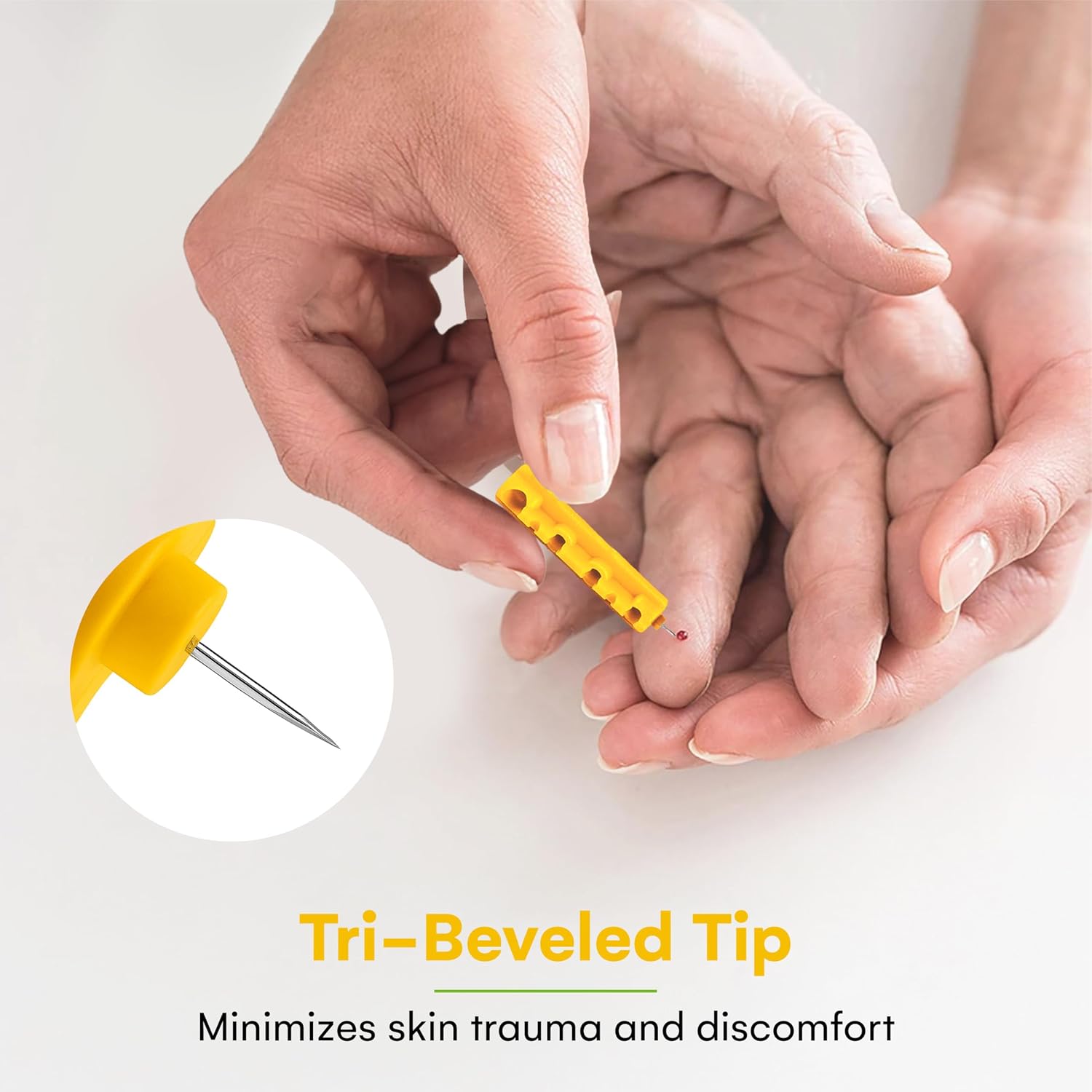
If you’ve ever gritted your teeth before a finger stick, the problem probably isn’t your glucose meter — it’s the lancing device (the small, spring-loaded pen that holds the needle and drives it into your fingertip to produce a blood drop). Most glucose meter kits include one as a freebie, and most of those freebies are… fine, until they’re not. Reviewers across multiple kit brands consistently flag the bundled lancing device as the first thing they’d replace. Depth settings feel imprecise. The spring force is uneven. The lancet — the tiny sterile needle inside — bends slightly on the third reuse and suddenly a routine test feels like a punishment. This guide is for anyone who’s already past the “how does this thing work” stage and is now asking the smarter question: which lancing device is actually worth owning?
We’ll walk through the real trade-offs: gauge versus reliability, pain versus blood volume, proprietary versus universal fit. We’ll name what owners report about specific devices and lancets, show you the cost math, and end with clear decision rules. Let’s get into it.
| EDITOR'S PICKOneTouch Delica Plus Lancets -… | Mid-tierAscensia MICROLET Lancets for G… | Budget pickTRUEplus Sterile Lancets 33 Gau… | |
|---|---|---|---|
| Gauge | 30-Gauge | 28-Gauge | 33 Gauge |
| Count | 180 | 100 | 200 |
| Coating | — | Silicone-coated | — |
| Sterile | — | ✓ | ✓ |
| Single-use | ✓ | ✓ | — |
| Multicolored | — | ✓ | — |
| Price | $24.89 | $12.10 | $6.42 |
| See on Amazon → | See on Amazon → | See on Amazon → |
Why the Bundled Device Is Usually the Weakest Link
Meter manufacturers are incentivized to keep kit costs down and sell you consumables — replacement lancets — at margin. The lancing device itself is treated as a loss-leader accessory, not a precision instrument. That calculus shows up in the hardware.
Reviewers of the iHealth kit meter have noted that the included lancet tool initially seemed broken, with at least one reviewer downgrading their rating specifically because of it — only to revise to five stars after discovering the issue was user technique, not device failure. That’s a design problem, not a user problem. If a device requires non-obvious technique to operate correctly, it will fail in the wild.
AUVON kit owners tell a starker story. A recurring theme in aggregated reviews: the bundled device “was not strong enough to pierce my skin,” while the AUVON standalone lancing device “works every time.” Same lancets, different device, dramatically different result. The standalone unit’s spring mechanism delivers more consistent penetration force — something that matters enormously for people with callused fingers, dry skin, or naturally thicker skin on their fingertips.
The Mayo Clinic’s patient education resource on blood glucose testing notes that lancing depth and technique both affect sample quality — too shallow and you get an inadequate sample, too deep and you increase discomfort and bruising risk. A device that can’t reliably hit the right depth range regardless of skin type is a clinical liability in daily use.
The Gauge Trade-Off: Pain vs. Reliability
Lancet gauge — the thickness of the needle — is the central tension in this category. Higher gauge numbers mean thinner needles. Thinner needles mean less pain. But thinner needles also mean smaller punctures, which can mean inadequate blood flow. This isn’t hypothetical.
By the Numbers
| Gauge | Needle Diameter | Best For | Risk |
|---|---|---|---|
| 28G | ~0.36 mm | Thick or callused skin | More discomfort |
| 30G | ~0.31 mm | Most adult users | Balanced |
| 33G | ~0.26 mm | Sensitive skin, children | Insufficient blood volume |
TRUEplus 33G lancet owners specifically call out the ultra-thin gauge as a double-edged sword. The pain reduction is real — multiple owners report near-painless sticks. But the re-stick rate goes up. When you need four readings a day, a lancet that requires two tries half the time is not saving you pain; it’s adding it. The Healthline overview of lancets for diabetes testing notes that 30G to 33G is the sweet spot for most adults, but individuals with thicker skin or poor circulation to the fingers may consistently need to move down (lower gauge number, bigger needle) to get reliable blood flow.
Care Touch 30G lancets occupy the middle ground that most users actually need. Owners consistently express genuine surprise at the low pain level — “I don’t even feel it” is a recurring phrase — while still reporting reliable blood drops on the first try. That combination is harder to find than it sounds, and it’s why 30G remains the volume seller in this category.
For frequent testers, the OneTouch Delica Plus system represents the premium end of the pain-reduction argument. Owners who test four times daily specifically describe the lancets as “worth it” — not because they’re magic, but because at that testing frequency, even a small reduction in per-stick discomfort compounds meaningfully over a week. The American Diabetes Association’s 2025 Standards of Care emphasizes that testing frequency adherence is directly tied to patient comfort; devices that hurt less get used more consistently.
Proprietary Fit vs. Universal Lancets: What Actually Fits What
This is one of the most common points of confusion, and it has real purchasing consequences.
Most standard lancets use a universal twist-off cap and fit the majority of lancing devices from any brand. If your device accepts standard lancets — which the majority of third-party and kit devices do — you have broad compatibility. Brands like Care Touch, TRUEplus, BD Ultra-Fine, and Advocate all use this standard form factor.
The exception worth knowing: Ascensia MICROLET lancets are designed specifically for Ascensia’s MICROLET NEXT lancing device. The color-coding on MICROLET lancets (blue, orange, yellow) is not decorative — each color corresponds to a specific gauge. They are functionally standard lancets in terms of sterility and sharpness, but the device-to-lancet pairing is optimized. If you’re using a MICROLET NEXT device, MICROLET lancets are the intended match. If you’re using another device, standard lancets will fit and work fine.
Accu-Chek’s FastClix system is the other major proprietary outlier. It uses a drum-style magazine of six lancets rather than individual needles, and those drums are not interchangeable with other devices. The trade-off: faster lancet changes, no needle-handling between sticks. For people with dexterity limitations or needle anxiety, that’s a real benefit. The cost per lancet runs higher than bulk-purchased universals, so the math matters if you’re testing frequently.
If you’re advising a patient panel or purchasing for a clinical setting, the practical rule is: default to devices that accept standard twist-cap lancets unless there’s a specific clinical reason to go proprietary. Compatibility flexibility reduces friction when a patient runs out of one brand and substitutes another.
Why Your Device Fails Even on the Deepest Setting
This is the question that generates the most frustration in online communities, and the answer is usually one of four things:
1. Skin preparation. Cold fingers have reduced circulation. Blood flow to fingertips drops significantly in cool environments. Warming hands under warm water for 30 seconds before testing materially increases blood volume at the puncture site. The FDA’s device guidance and multiple clinical education resources list this as a primary technique step — it’s not optional if you’re struggling for blood volume.
2. Device age and spring fatigue. Lancing device springs lose tension over time. A device that performed well at 12 months may deliver meaningfully less penetration force at 24 months. If your device is old and you’re suddenly struggling on settings that used to work, the device may simply need replacing.
3. Lancet reuse degradation. The tip of a lancet bends microscopically after the first use. By the third or fourth use, the tip is no longer a clean puncture instrument — it tears rather than pierces, increasing both discomfort and the likelihood of inadequate blood flow. The Mayo Clinic’s guidance on blood glucose testing is explicit that lancets are designed for single use. The FDA classifies lancets as single-use devices. Reuse is common in practice, but it’s the first variable to control when troubleshooting blood volume problems.
4. Site selection. The fingertip contains the highest concentration of nerve endings. Side-of-fingertip lancing (targeting the fleshy pad just off-center from the fingerprint) typically yields better blood flow with less pain than center-of-fingertip sticks. Rotating sites prevents callus buildup at any single location, which directly affects how much force the device needs to deliver.
Safety Lancets vs. Standard Twist-Top: Knowing the Difference
A standard twist-top lancet is what comes in most bulk lancet boxes. You load it into a lancing device, use the device’s spring mechanism to drive it in, and discard the lancet after use. The needle is never exposed until the device fires, and retracts after firing (in most modern devices).
A safety lancet is a self-contained unit — no separate lancing device required. You press it against the skin, it fires and retracts automatically, and the needle locks in the retracted position so it can’t be reused or cause accidental sticks during disposal. Safety lancets are common in clinical settings, school nurse offices, and situations where multiple caregivers may be involved in testing a single patient. They’re also the right choice for people with significant dexterity limitations who struggle to load traditional lancets. They cost more per unit than bulk lancets, and they don’t offer depth adjustment.
For home self-testing in adults, standard lancets with a quality adjustable lancing device remain the more economical and flexible choice. For caregivers managing testing for children or aging parents — particularly in settings with multiple people handling the devices — safety lancets reduce sharps exposure risk meaningfully.
Frequently Asked Questions
Do lancets from one brand fit all lancing devices, or are some proprietary? Most standard lancets use a universal form factor and fit the vast majority of lancing devices. The main exceptions are the Accu-Chek FastClix drum system and Ascensia MICROLET lancets, which are optimized for their respective devices. When in doubt, check the lancing device’s manual for “compatible lancet gauge” rather than brand — if it lists gauges without brand restrictions, it accepts universal lancets.
What gauge is best if I have thick skin and struggle to get a blood drop? Start with 28G or 30G rather than going thinner. Thicker skin requires more penetration surface area to produce reliable blood flow. Combine that with proper site preparation (warm hands, side-of-fingertip placement) before adjusting gauge further.
Is it safe to reuse a lancet more than once? The FDA classifies lancets as single-use devices, and the Mayo Clinic’s guidance supports this position. Reuse is common in practice, but the needle tip degrades after first use, increasing both discomfort and the risk of inadequate blood volume. If you’re troubleshooting poor blood flow, switching to a fresh lancet is the first variable to control.
What’s the difference between a safety lancet and a standard twist-top lancet? A standard lancet requires a separate lancing device and offers depth adjustment. A safety lancet is self-contained, fires and permanently retracts in one motion, and cannot be reused. Safety lancets are better for clinical or multi-caregiver settings; standard lancets are more economical for daily home use.
Why does my lancing device sometimes fail to produce enough blood even on the deepest setting? Most commonly: cold fingers reducing circulation, lancet reuse degradation, or spring fatigue in an aging device. Warm your hands first, use a fresh lancet, and try side-of-fingertip placement before assuming the device is broken.
Are colored lancets (like Ascensia MICROLET) functionally different from plain ones? The color coding on MICROLET lancets indicates gauge — the lancets themselves are sterile and sharp regardless of color. Colored lancets from other brands are typically a manufacturing convenience for identifying gauge at a glance, not a functional distinction.
The Decision Rule
Here’s how to frame the upgrade choice:
- If you’re struggling to get blood on the deepest setting → the device is the problem, not the lancet gauge. Move to a standalone device with a stronger spring mechanism before changing gauge.
- If lancing hurts but blood flow is adequate → move to a higher gauge (thinner needle) lancet. Care Touch 30G is the lowest-risk starting point for most adults.
- If you test four or more times daily → prioritize the lancing device and lancet combination rated for comfort at high frequency. OneTouch Delica Plus owners at that cadence consistently report the investment pays off.
- If you’re purchasing for a caregiver or clinical setting → default to safety lancets for sharps safety, and universal-fit devices to maximize lancet sourcing flexibility.
- If you’re advising a patient panel → 28G or 30G universal lancets paired with an adjustable standalone device covers the widest range of skin types without requiring re-education when supplies run low.
The bundled device that came with your meter got you started. It doesn’t have to be what you use for the next decade of testing.