Safety Lancets vs. Twist-Top Lancets vs. Lancing Devices: Which Setup Hurts Less?
Every blood sugar check starts the same way: a tiny needle pricks your fingertip to release a drop of blood. That needle — the lancet — comes in a few different forms, and the form matters a lot for comfort. A lancet is simply a small, sterile needle designed for a single skin puncture. Some lancets are built into a self-contained plastic shell you press directly against your finger (called safety lancets or auto-lancets). Others are bare needles that load into a reusable spring-powered lancing device — think of it as a pen-shaped mechanism that controls the speed and depth of the stick. A third format, the twist-top lancet, is essentially the bare-needle version most compatible with standard lancing devices.
If you’re checking your glucose once or twice a day, the pain question feels minor. If you’re checking four, six, or eight times daily — or managing a child with Type 1 — it stops being minor fast. This guide breaks down the real-world tradeoffs between each format, names the specific signals worth caring about across aggregated buyer reviews, and ends with a clear decision rule so you can stop overthinking the lancet aisle.
| EDITOR'S PICKOneTouch Delica Plus Lancets -… | Mid-tierAscensia MICROLET Lancets for G… | Budget pickTRUEplus Sterile Lancets 33 Gau… | |
|---|---|---|---|
| Count | 180 | 100 | 200 |
| Gauge | 30 | 28 | 33 |
| Sterile | — | ✓ | ✓ |
| Single-use | ✓ | ✓ | — |
| Silicone-coated | — | ✓ | — |
| Color-coded | — | ✓ | — |
| Price | $24.89 | $12.10 | $6.42 |
| See on Amazon → | See on Amazon → | See on Amazon → |
The Three Formats, Compared Honestly
Safety Lancets (Press-and-Release, No Device Needed)
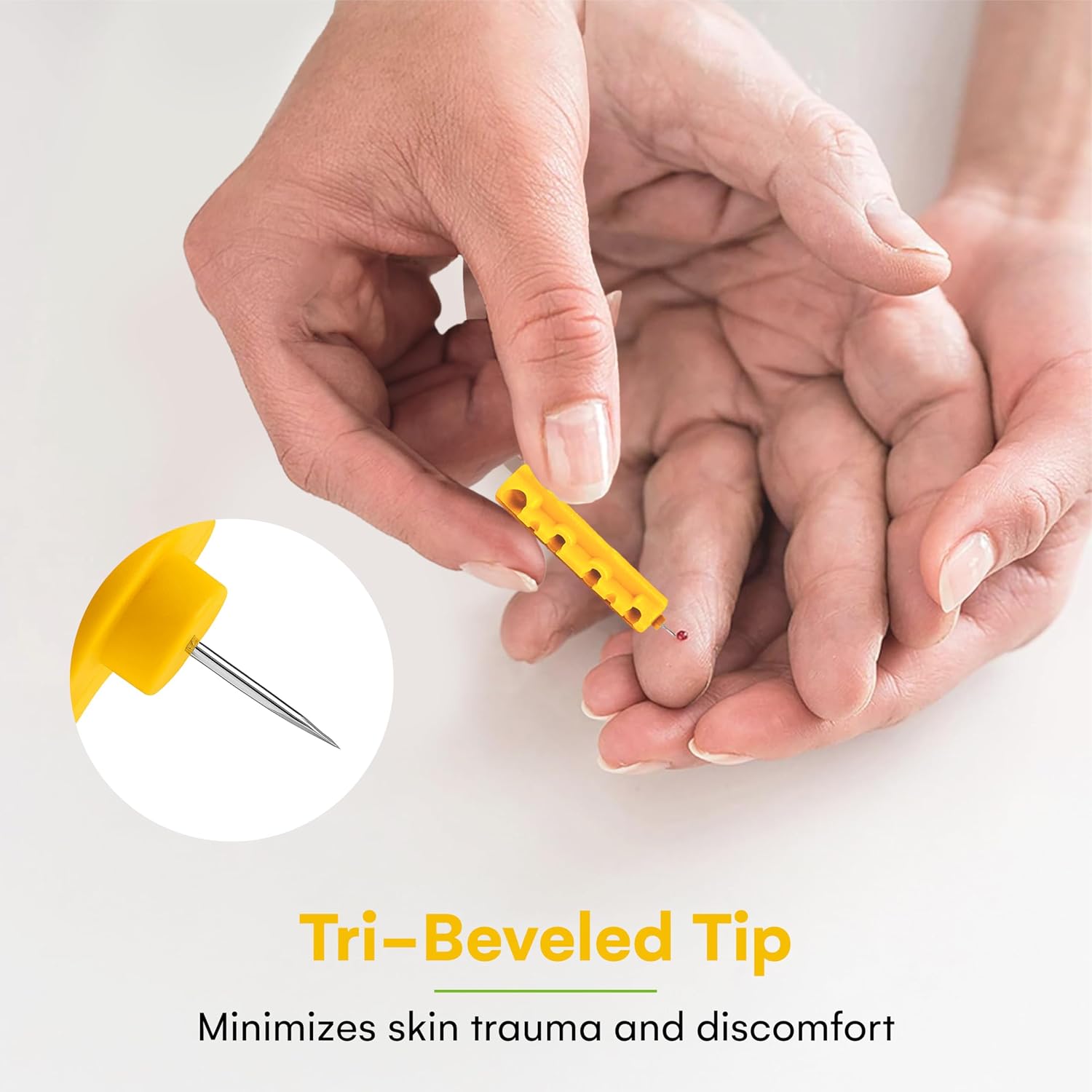
Safety lancets — sometimes called auto-lancets or single-use lancing pens — are self-contained. You twist off a cap, press the device against your fingertip, and the mechanism fires automatically. There’s no separate lancing device to load, no depth dial to fiddle with, and no exposed needle before or after use.
The Pip lancet is the flagship example of this format, and the language buyers use in aggregated reviews is genuinely striking. Phrases like “barely left a mark” and “didn’t even feel it” show up repeatedly. That kind of praise is unusual in a category where most people assume some discomfort is unavoidable. The Pip uses a 30-gauge needle and a very shallow default depth, which means it punches for the minimum blood volume needed — not more. That works well for most fingertip checks with modern high-sensitivity meters that need only 0.3–0.5 µL of blood (per the American Diabetes Association, Standards of Medical Care in Diabetes 2024, which notes that modern meters require substantially smaller samples than earlier-generation devices).
Who this is actually for: Needle-averse buyers. People who need to check occasionally, like those with prediabetes or gestational diabetes doing spot checks. Travelers who don’t want to carry or sterilize a lancing device. Caregivers managing a child who freezes at the sight of a lancet pen.
The tradeoff: Cost per stick is higher. A safety lancet runs $0.20–$0.50 per unit. If you’re checking 5x daily, that’s $365–$900/year just in lancets before you factor in strips or CGM sensors. They’re FSA/HSA eligible, but at that volume the math starts to sting differently.
Twist-Top Lancets + a Reusable Lancing Device
This is the most common setup in the market and the format most people inherit from a meter kit. You load a twist-top lancet (the most universal design) into a lancing device, set a depth dial (usually 1–7, with higher numbers penetrating deeper), and fire.
The core problem most buyers don’t realize: the bundled lancing device in most meter kits is often the weakest component. Across aggregated reviews for devices like the AUVON lancing device, a consistent pattern emerges — buyers describe a clear “before and after” when they swap out the kit-supplied device for a $10–$15 aftermarket option. The language is specific: less bruising, less drag, more consistent blood volume. The mechanism difference is real. Better lancing devices use a finer spring tension and a narrower aperture that guides the lancet more cleanly, reducing the lateral drag that causes bruising.
The OneTouch Delica Plus earns a specific callout here for a practical detail that reviewers keep flagging: the lancet cap can be re-twisted onto the lancet after use, effectively recapping the needle for safe disposal. For caregivers dealing with sharps waste in a home with children, or for travelers who can’t immediately access a sharps container, this isn’t a minor point. Per FDA guidelines on safe sharps disposal (FDA, Blood Glucose Monitoring Devices — Class II Special Controls), recapping is generally discouraged as a routine practice but acknowledged as sometimes necessary for temporary containment — the Delica Plus design accommodates this without forcing an awkward workaround.
The TRUEplus 33G lancet deserves honest treatment here because it illustrates a tradeoff that matters at the practitioner level. Reviewers explicitly name the pain/blood-volume problem: the lancet is so thin (33 gauge is among the finest available) that at shallow depth settings, it sometimes fails to produce a usable drop — requiring a re-stick. Two shallow pricks are more uncomfortable and more damaging to fingertip tissue over time than one correctly-calibrated stick. The lesson: finer gauge does not automatically mean better outcome. Gauge interacts with depth setting, skin thickness, and meter sensitivity. Going ultra-fine only pays off if your depth calibration is dialed in and your meter requires ≤0.5 µL.
The Care Touch lancet surfaces an interesting data point from an off-label use review (acne lancing) that inadvertently validates something useful: a buyer used the lancet for a dermatological purpose and commented on its precision and sterility. That reviewer wasn’t trying to make a product argument — they were solving a different problem — but the incidental endorsement of sharpness and sterile packaging consistency is informative for anyone evaluating lancet quality across a box of 100.
By the numbers:
| Format | Approx. cost/stick | Gauge range | Device required? | FSA/HSA eligible? |
|---|---|---|---|---|
| Safety lancet (Pip) | $0.25–$0.50 | 28–30G | No | Yes |
| Twist-top + device (AUVON) | $0.04–$0.10 | 28–33G | Yes | Yes |
| Delica Plus lancets | $0.08–$0.12 | 33G | Yes | Yes |
| TRUEplus 33G | $0.05–$0.08 | 33G | Yes | Yes |
Why the Same Lancet Feels Different Day to Day
This is the question buyers struggle with most, and the answer involves more variables than the lancet itself.
Skin hydration matters. Dry fingertips require more force to penetrate, which means a depth setting that worked yesterday may produce insufficient blood today. Per Healthline’s overview of finger-stick blood testing, warming the hands before a check — by rubbing them together or running warm water — increases blood flow to the fingertips and often produces a better drop at a shallower depth setting.
Lancet reuse degrades the tip. A lancet is engineered to be sharp for exactly one use. Under microscopic examination, a reused lancet shows measurable tip deformation after a single firing — a point Mayo Clinic’s guidance on blood sugar testing explicitly raises. That degraded tip creates more drag, more tissue trauma, and more variable blood volume. The uncomfortable truth: most people reuse lancets regularly, and most people also wonder why their fingertips feel worse over time. The correlation is direct.
Depth setting drift. Lancing devices with worn spring mechanisms deliver inconsistent force across their depth range. If you’ve had the same device for two years and the “3” doesn’t feel like it used to, the spring may have fatigued. This is an underappreciated reason to replace a lancing device periodically.
Gauge, Depth, and the Pain Hierarchy
Gauge describes needle thickness using an inverse scale — higher number means thinner needle. A 33G lancet is thinner than a 28G lancet.
Thinner is not always better, as the TRUEplus 33G situation illustrates. The practical hierarchy looks like this:
- 28–30G is appropriate for most users, especially those with thicker skin, callused fingertips, or meters requiring larger sample volumes (≥1.0 µL)
- 30–33G works well for users with sensitive fingertips, children, or anyone using a high-sensitivity meter requiring ≤0.5 µL
- 33G specifically requires precise depth calibration; it’s unforgiving of poor device fit or skin variability
The Pip safety lancet sits at 30G and handles most adult users without depth-calibration anxiety because its mechanism is pre-calibrated for the target depth. That’s the real advantage: removing a variable rather than optimizing it.
Frequently Asked Questions
1. What gauge lancet hurts the least? Higher gauge (thinner needle) generally causes less pain, but only if it produces sufficient blood in one stick. A 33G lancet that requires a re-stick is more painful overall than a 30G that works the first time. For most adults, 30G or 31G is the practical sweet spot.
2. Do I really need a lancing device, or can I use a safety lancet instead? No, you don’t need a lancing device. Safety lancets like the Pip are complete, self-contained, and FDA-cleared for blood glucose sampling. The practical limit is cost: at daily checking frequency, safety lancets cost 3–5x more per stick than reloadable lancets. For occasional use or needle-averse users, the cost premium is worth it.
3. Why do I sometimes get enough blood and sometimes not from the same lancet? Skin hydration, hand temperature, depth setting accuracy, and lancet sharpness all interact. Reused lancets are a major culprit — tip deformation after a single use is real even if invisible. Warming hands before the check and using a fresh lancet consistently reduces variability.
4. Are lancets from one brand compatible with any lancing device? Most twist-top lancets use a near-universal barrel size (often called the “universal fit” standard) compatible with the majority of lancing devices. However, some devices — notably the OneTouch Delica Plus system and certain Accu-Chek devices — use a proprietary lancet design. Check compatibility before purchasing lancets in bulk.
5. How often should I actually change my lancet? Clinically, every single use. Practically, the consensus among diabetes educators (per American Diabetes Association guidance) is that reuse increases pain and tissue damage over time. At minimum, change lancets daily. Changing every check is the best practice, especially for anyone with thickened or bruised fingertips.
6. Is a 33-gauge lancet better than 30-gauge for daily use? Not automatically. The 33G is better only if: your meter requires ≤0.5 µL sample, your lancing device delivers consistent depth, and your fingertips don’t run dry or calloused. For most daily-use scenarios, 30G or 31G delivers a better combination of reliable blood volume and low pain.
The Decision Rule
If you check infrequently, are highly needle-averse, or are managing a child who dreads the lancet → the Pip safety lancet’s pre-calibrated mechanism and strong “didn’t feel it” owner consensus make the higher per-stick cost rational.
If you check 4+ times daily and want to minimize cost without sacrificing comfort → a quality aftermarket lancing device (AUVON is the most-cited upgrade in this segment) plus 30G or 31G twist-top lancets is the highest-value setup. Replace the lancet every check; replace the device annually.
If you’re using an ultra-fine 33G lancet and keep getting insufficient blood drops → the problem isn’t the lancet, it’s the depth calibration or device fit. Dial up one setting before switching gauge entirely.
If sharps disposal is a genuine constraint (travel, home with children, no sharps container access) → the OneTouch Delica Plus’s recap mechanism is a meaningful practical feature, not a marketing footnote.
The lancet is the cheapest consumable in your diabetes toolkit and also the most directly responsible for daily comfort. Getting it right is worth 20 minutes of research — which you’ve now done.