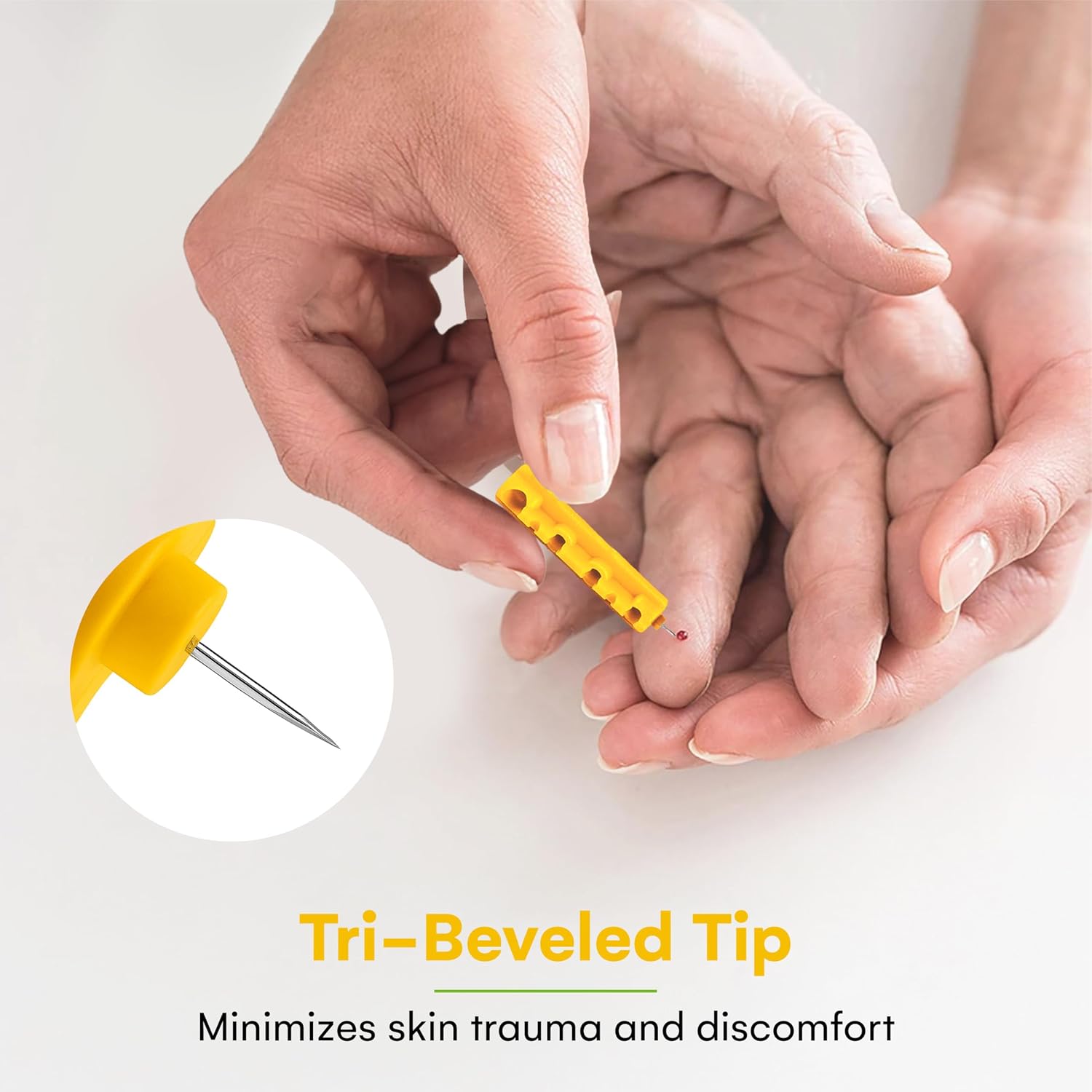
If you’ve ever winced at a finger stick and immediately blamed your lancing device, you’re not alone — and you’re probably wrong. A lancing device (the spring-loaded pen you click to drive the needle) is just the delivery system. The lancet itself — a tiny needle inside a plastic cap that you replace each time — is doing the actual work. Lancets come in different gauges, which is just the engineering word for needle thickness. The higher the gauge number, the thinner the needle. A 28-gauge lancet is noticeably thicker than a 33-gauge one. Most people who report dramatically less pain after a product switch didn’t change their device. They changed their lancet gauge, their lancet’s surface coating, or both. This guide unpacks that distinction, walks through the real tradeoffs between thinner and thicker gauges, and gives you a clear decision rule for matching lancet to hand.
| EDITOR'S PICKOneTouch Delica Plus Lancets -… | Mid-tierAscensia MICROLET Lancets for G… | Budget pickTRUEplus Sterile Lancets 33 Gau… | |
|---|---|---|---|
| Gauge | 30-gauge | 28-gauge | 33 gauge |
| Quantity | 180 | 100 | 200 |
| Silicone-coated | — | ✓ | — |
| Multi-colored | — | ✓ | — |
| Sterile | — | ✓ | ✓ |
| Single-use | ✓ | ✓ | — |
| Price | $24.89 | $12.10 | $6.42 |
| See on Amazon → | See on Amazon → | See on Amazon → |
The Gauge Number Is the Variable That Actually Moves the Needle on Pain
Think of gauge the same way you’d think about blood-draw needle sizing at a lab: the finer the needle, the less tissue disruption on entry. Across aggregated reviews of lancet products in the 28G–33G range, the pattern is remarkably consistent. Buyers who step down from a thick-gauge lancet (28G or 30G, common in many bundled kits) to a 33G option describe the change in language that signals genuine surprise — not mild improvement. Phrases like “felt no pain, just a little pressure” appear repeatedly in verified purchase reviews of Care Touch 33G lancets, often from people who’d been testing daily for years and assumed discomfort was simply part of the ritual.
That surprise has a physiological basis. The fingertip is densely innervated — the Mayo Clinic’s overview of blood sugar testing notes it’s among the most sensitive skin zones on the body. A narrower-diameter puncture displaces less tissue and activates fewer pain receptors. Published specs put Care Touch lancets at 33G; Medline’s TRUEplus line also produces a 33G option. The FDA’s 510(k) device classification database confirms these gauges as cleared for consumer self-testing use.
By the numbers:
| Gauge | Relative diameter | Common pain perception (aggregated reviews) | Blood volume yield |
|---|---|---|---|
| 28G | Thickest common | Higher | Most reliable |
| 30G | Mid-range | Moderate | Reliable |
| 33G | Thinnest widely available | Lowest | Occasionally needs re-stick |
The tradeoff embedded in that table is real and worth naming explicitly: 33G lancets occasionally require a second stick to produce enough blood for a test strip, particularly for people with thicker skin, lower body temperature, or poor peripheral circulation. TRUEplus 33G reviewers flag this directly — not as a device failure, but as a gauge-depth mismatch. The needle is so fine that at shallow depth settings, it may not reach the capillary layer. The fix is usually one click deeper on the depth dial, not a switch back to a thicker gauge.
Silicone Coating: The Underrated Variable Most Buyers Ignore
Gauge gets most of the attention. Coating gets almost none — until someone tries a silicone-coated lancet and then has to explain to their diabetes educator why they care so much about a two-cent needle.
Silicone coating (sometimes called lubricant coating or low-friction coating in manufacturer documentation) reduces drag as the lancet tip enters and exits skin. Uncoated lancets exist and work fine, but the entry-exit friction is perceptibly higher under daily use conditions. The Ascensia MICROLET NEXT lancets, for example, carry a five-tip silicone coating and are reviewed by users who emphasize how little they feel compared to kit-default lancets. Reviewers describing colorful cap designs — the MICROLET’s cheerful multicolored options are frequently mentioned — are signaling something clinically meaningful: when a product feels less clinical and less associated with pain, adherence improves. That’s not a trivial detail for someone testing four times a day.
Everyday Health’s 2025 roundup of best lancets for blood sugar testing specifically calls out silicone coating as a differentiating feature between lancets at equivalent gauge, noting that friction reduction during insertion is the mechanism. The Healthline overview of finger-stick testing echoes this, recommending that users change lancets with every stick partly because reused lancets lose their coating after a single puncture — the tip microscopically deforms, and the lubricant layer is essentially spent.
Depth Setting vs. Gauge: Knowing Which Lever to Pull
Here’s the decision frame that most people never receive from their prescribing clinician: gauge and depth setting are two separate controls, and they interact.
Gauge determines how much tissue gets displaced on puncture. Depth setting (the numbered dial on your lancing device, typically 1–7 or 1–9 depending on the brand) determines how far the lancet tip travels into the skin.
The combination that produces the least pain while still yielding adequate blood volume is:
- Thinnest gauge your skin allows (start at 33G if skin is thin or sensitive)
- Shallowest depth setting that produces a drop (start at 3–4, adjust up one click if blood volume is inadequate)
An AUVON lancing device reviewer illustrates why this matters: they reported switching devices because their previous kit “would occasionally fail to create a finger prick that produced enough blood.” The intuitive diagnosis is a device problem. The actual diagnosis, in most reported cases like this, is a gauge-depth mismatch — typically a thin lancet at too shallow a depth, or a thick lancet at a depth appropriate for a thinner one. Neither variable alone tells the complete story.
The American Diabetes Association’s Standards of Medical Care 2025 (Section 7, Diabetes Technology) does not prescribe a specific gauge for self-monitoring but does recommend rotating test sites and adjusting technique to minimize cumulative tissue damage — an implicit endorsement of finding the lowest-trauma configuration that still yields a valid reading.
A practical calibration protocol for someone rethinking their setup:
- Load a 33G silicone-coated lancet.
- Set depth to 3 (or equivalent mid-low on your device’s scale).
- Test on the side of a fingertip, not the pad center (less innervated).
- If blood volume is insufficient for the strip, increase depth by one click.
- If pain increases significantly, step back to 30G at the same depth.
Most people land on 33G at depth 4–5, or 30G at depth 3–4, and report significantly reduced discomfort compared to kit defaults (which often ship at 30G with depth pre-set at 5 or 6).
Device Compatibility: Don’t Let It Limit Your Lancet Choice
One practical question that stops many people from experimenting with better lancets: will this lancet fit my device?
The short answer is: almost certainly yes. The vast majority of lancets sold in the U.S. consumer market follow a standard 28-gauge twist-cap form factor that fits the universal lancet port used by Accu-Chek, OneTouch, Contour, and most no-brand lancing devices. Care Touch 30G and 33G lancets, for example, are explicitly reviewed as compatible with OneTouch and Contour devices. The MICROLET lancets are designed for Ascensia’s MICROLET NEXT device but also fit many universal-port devices.
The exceptions to watch for: Accu-Chek’s Softclix system uses a proprietary lancet form factor. If you’re using a Softclix device, your lancet pool is narrower. Pip lancets (a safety-first design popular with needle-anxious users and children) are self-contained and not compatible with standard devices at all — they function as an integrated unit. Pip users in reviews describe the experience as “my life just got a little better,” which captures something real about the anxiety-reduction value of retractable safety designs even if they sacrifice some gauge flexibility.
How Often to Change Your Lancet (And Why This Changes Your Pain Math)
The honest answer: every single use. The clinical recommendation from the ADA and the Healthline clinical overview both support single-use replacement. The realistic answer for most people: less often than that, which directly affects pain.
A used lancet tip is microscopically barbed after one puncture. The silicone coating is depleted. The tip geometry is no longer the manufacturer-rated shape. Testing with a used lancet at the same gauge as a fresh one is functionally equivalent to testing with a slightly thicker, uncoated lancet. If you’re testing four times daily and replacing lancets daily rather than per-use, you’re experiencing the equivalent of three painful sticks for every comfortable one.
The cost math makes this easy to justify. Lancets are among the cheapest consumables in the diabetes supply chain. A 100-count box of quality 33G lancets runs well under $10 at most price points (often $5–$8). At four tests per day, that’s 120 lancets per month — roughly $6–$10/month for full per-use replacement. That’s a rounding error in the monthly supply budget for anyone also buying test strips or CGM sensors. The friction of changing more often is behavioral, not financial.
Frequently Asked Questions
What lancet gauge hurts the least for daily blood sugar testing? Across aggregated reviews, 33G lancets consistently produce the lowest pain reports. They are the thinnest gauge widely available for consumer self-testing. The tradeoff is occasional inadequate blood volume, especially at shallow depth settings or with poor circulation.
Do silicone-coated lancets actually feel different from uncoated ones? Yes, in a measurable way. Silicone coating reduces insertion and withdrawal friction. Reviewers who switch from uncoated to coated lancets at the same gauge report perceptibly less discomfort. The effect diminishes after a single use as the coating is depleted — which is the primary reason per-use replacement is recommended.
Will a 33-gauge lancet always produce enough blood for my test strip? Not always. Thinner-skin users generally have no issue. People with thicker skin, cooler hands, or circulation challenges may need to increase their depth setting by one or two clicks. Warming the hand before testing (rubbing it or running it under warm water) also improves blood volume at any gauge.
Are Care Touch lancets compatible with my OneTouch or Contour lancing device? Based on published product specifications and reviewer reports, Care Touch lancets use the universal twist-cap form factor compatible with most lancing devices including OneTouch and Contour models. Confirm your device uses a standard (non-proprietary) lancet port before purchasing any new lancet brand.
Should I use a thinner gauge or a shallower depth setting to reduce pain? Both levers reduce pain, but they work differently. Thinner gauge reduces tissue displacement on entry. Shallower depth reduces penetration distance. The most effective approach is to use the thinnest gauge that yields adequate blood, then fine-tune depth — rather than using a thick gauge at shallow depth, which often produces the worst of both worlds: still painful, still insufficient blood.
How often should I change my lancet if I test four times a day? With every single test, per clinical guidelines from the ADA and FDA-cleared product labeling. At four daily tests and roughly $6–$10/month for 33G lancets, the cost of per-use replacement is minimal compared to the cumulative pain and tissue trauma of reuse.
FSA/HSA eligibility note: Lancets are FSA/HSA-eligible expenses under IRS Publication 502 as medical supplies for diabetes management. Keep purchase receipts and verify with your plan administrator if purchasing a multi-brand bundle.