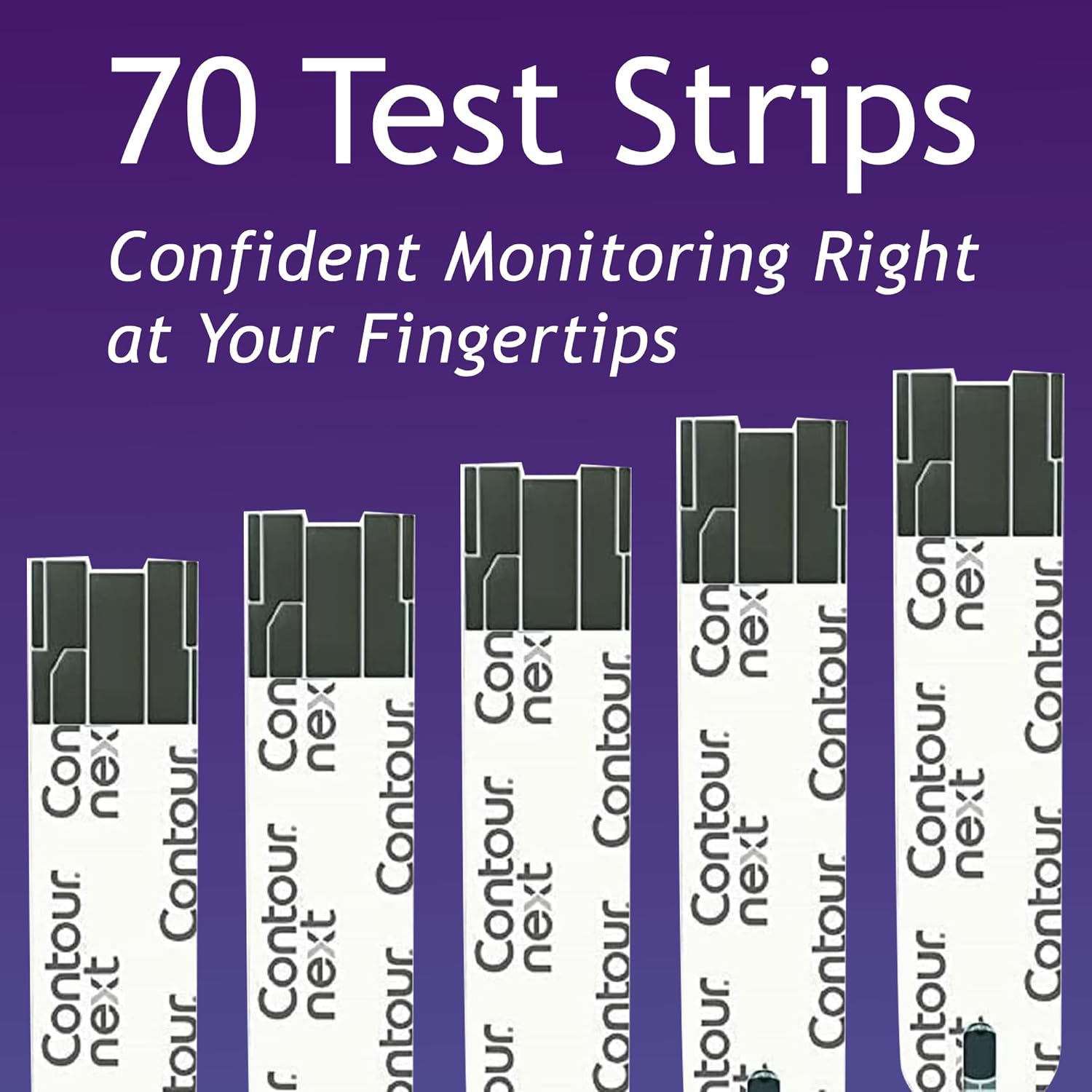
If you’ve recently been diagnosed with diabetes — or you’re helping someone who has — here’s the quick version of what this article is about: a glucose test strip is a small disposable stick you insert into a blood sugar meter. You prick your finger, touch a drop of blood to the strip, and the meter tells you your glucose level. Strips are consumed every single time you test, which means strip cost adds up fast over weeks and months. Two features on strips come up constantly in buying decisions: second-chance sampling (the ability to add more blood to a strip if your first drop wasn’t enough, without wasting the strip) and no-coding (strips that don’t require you to enter a calibration code before use). Both sound minor. As you’ll see below, one of them matters a lot more than the other — and neither one is the most important variable in most real-world purchase decisions.
| EDITOR'S PICKNipro Diagnostics True Metrix M… | Mid-tierAscensia Contour Next Blood Glu… | Budget pickAccu-Chek Guide Glucose Test St… | |
|---|---|---|---|
| Strip count | 150 | 70 | 50 |
| No coding | — | ✓ | — |
| Second-chance | — | ✓ | — |
| Meter compat. | True Metrix | All Contour Next | Guide |
| Price | $41.49 | $23.97 | $22.00 |
| See on Amazon → | See on Amazon → | See on Amazon → |
Why Strip Features Get More Attention Than They Deserve — and What Actually Drives Outcomes
Let’s establish the decision frame clearly: when someone is comparing Contour Next against TRUE METRIX against CareSens N against Metene TD-4116, they’re usually not running a spec-sheet comparison. They’re reacting to a monthly cost problem, a workflow annoyance, or a family member who quietly stopped testing because strips were too expensive.
That last pattern shows up across aggregated reviews with striking consistency. Multiple reviewers across major strip brands describe the same dynamic: a parent, spouse, or the reviewer themselves had reduced or stopped testing when strip costs climbed, then resumed after switching to a more affordable option. The American Diabetes Association’s Standards of Medical Care in Diabetes — 2025 notes that cost-related non-adherence to self-monitoring is a documented barrier to glycemic management. This isn’t a consumer-preference anecdote. It’s a clinical outcome variable.
So when you’re evaluating strips, the decision tree has to start with cost-per-strip math, not feature comparison. Then features become tiebreakers.
The Real Math: Cost Per Strip, Not Cost Per Box
Here’s the number that drives everything else.
Strip cost reference points (May 2026, approximate retail):
| Brand | Typical count | Approx. cost per strip |
|---|---|---|
| ReliOn Platinum | 100-ct | ~$0.18 |
| TRUE METRIX | 100-ct | ~$0.22–$0.28 |
| CareSens N | 100-ct | ~$0.25–$0.30 |
| Metene TD-4116 | 100-ct | ~$0.20–$0.25 |
| Contour Next | 70-ct | ~$0.35–$0.45 |
| OneTouch Verio | 100-ct | ~$0.55–$0.75 |
At four tests per day — a reasonable baseline for someone on insulin — the spread between a $0.18 strip and a $0.65 strip is $173/month vs. $78/month. That’s $1,140/year in difference before insurance. If a patient is paying out-of-pocket or on a high-deductible plan, that gap changes behavior. Consumer Reports’ blood glucose meters buying guide consistently flags this as the primary cost driver that gets overlooked when buyers focus on meter hardware.
TRUE METRIX owners specifically note Amazon pricing as a reason to choose their strips over pharmacy purchases. CareSens N users frequently mention that the system requires less blood than prior OneTouch setups — which matters for fingertip comfort over time, but the cost switch is almost always mentioned first.
If your patient, family member, or you are testing fewer times than recommended, start the evaluation with strip cost. Everything else is secondary.
Second-Chance Sampling: What It Actually Prevents
Second-chance sampling — sometimes called “re-dose” capability — means that if you touch the strip and the blood drop isn’t large enough to complete the reading, you can add more blood within a short window (typically 60 seconds) rather than discarding the strip and starting over.
Here’s the honest framing: second-chance sampling primarily prevents wasted strips, not inaccurate readings. A strip that received insufficient blood will give you an error code, not a falsely high or low number — modern strips are designed to fail loudly, not silently. The FDA’s guidance on blood glucose monitoring test systems for prescription point-of-care use describes fill-trigger confirmation as a core accuracy mechanism; an underfilled strip errors out rather than reporting.
So the value of second-chance sampling is economic and ergonomic, not accuracy-related. For someone with:
- Peripheral neuropathy causing reduced fingertip sensation (smaller, harder-to-control drops)
- Cold hands in winter (vasoconstriction reduces blood flow)
- Children or older adults being tested by a caregiver
…the ability to re-dose without wasting a strip can meaningfully reduce monthly strip consumption. Contour Next strips are the most cited example in long-run owner reviews: users consistently report multi-year reliability and fewer strip-waste events than prior meters. One aggregated review pattern shows owners using Contour Next continuously for three to four years and citing re-dose capability alongside small sample size (0.6 µL) as the two features that made the difference in day-to-day usability.
For someone with good fingerstick technique and reliable blood drops, second-chance sampling is a nice-to-have, not a must-have.
No-Coding: A Solved Problem That Still Confuses Buyers
“Coding” was a legitimate issue in older meter generations. Each new vial of strips had a slightly different chemical calibration, and you had to manually enter a code printed on the vial into your meter. Entering the wrong code produced systematically off readings — not dramatic errors, but enough to affect clinical decisions at the margin.
Most meters sold today are no-code by design. The calibration information is embedded in a chip on the strip itself; the meter reads it automatically. Metene TD-4116 reviewers frequently highlight the no-coding feature alongside the large display as reasons the system feels simple and reliable. But here’s the practitioner-level note: “no-coding” is now a baseline feature, not a differentiator. If you’re seeing it listed as a premium feature, that’s marketing language for a problem that’s been solved across the mainstream market since roughly 2015.
The only context where coding still matters: a small number of older meters — particularly those given to patients years ago and never replaced — do require code entry. If you’re advising a patient who’s been using the same meter for a decade, it’s worth checking. Healthline’s overview of best glucose meters notes that coding-required systems are increasingly rare in current retail but do persist in some legacy setups.
Decision rule on no-coding: if the meter was purchased in the last five to seven years, it almost certainly auto-codes. Don’t pay a premium for “no-coding” as a feature. Do confirm your meter model isn’t one of the legacy exceptions.
The Strip-Accuracy Question: ISO Standards and What They Mean in Practice
All strips sold in the U.S. must meet FDA clearance requirements, which reference ISO 15197:2013 accuracy standards. That standard requires 95% of readings to fall within ±15 mg/dL (for readings below 100 mg/dL) or ±15% (for readings above 100 mg/dL) of a reference value.
Consumer Reports’ blood glucose meters buying guide notes that some strips consistently perform better than the minimum standard in independent testing — Contour Next has scored well in independent accuracy evaluations — while others cluster near the lower boundary of acceptable variance.
What does this mean practically?
- At a glucose of 200 mg/dL, a ±15% variance allows readings between 170 and 230. That’s a 60-point range that can affect dosing decisions.
- At a glucose of 80 mg/dL (near-hypoglycemia), ±15 mg/dL allows readings between 65 and 95. The difference between “act on this” and “do nothing” can live in that window.
If accuracy at the margins matters — someone on insulin, someone prone to hypoglycemia, someone whose clinical team is making titration decisions from meter data — the argument for Contour Next’s historically strong accuracy profile is a real clinical argument, not just a branding one. The cost premium over budget strips reflects something that has real-world consequences.
For someone managing prediabetes with diet and lifestyle, tracking trends rather than chasing precise numbers, the accuracy difference between ISO-compliant strips is unlikely to change outcomes.
Frequently Asked Questions
Do no-coding strips work with any meter, or only brand-matched ones?
No-coding strips are matched to their own meter system. The auto-calibration chip on a Contour Next strip communicates with a Contour meter specifically. You can’t use Contour Next strips in a TRUE METRIX meter. “No-coding” means you don’t have to enter a code manually — it doesn’t mean universal compatibility. Strip-to-meter matching is always required regardless of coding method.
What does second-chance sampling actually prevent — wasted strips or inaccurate readings?
Primarily wasted strips. An underfilled strip on a modern meter will display an error and prompt you to re-dose (within a window, typically up to 60 seconds) rather than produce a false reading. Second-chance sampling saves you from discarding and restarting with a new strip. It does not improve reading accuracy on a successfully filled strip.
Are Amazon-sold strips the same as pharmacy strips, or are they different lots?
Major brand strips sold by the brand’s own storefront or authorized sellers on Amazon are the same product as pharmacy versions. The meaningful variable is seller authorization, not channel. Strips from third-party marketplace sellers warrant more scrutiny — check expiration dates carefully and confirm the seller is authorized. TRUE METRIX owners specifically cite Amazon pricing as a cost advantage over pharmacy retail, which reflects legitimate channel pricing differences, not product differences.
How long do open test strip vials stay accurate?
Most manufacturers specify 3 to 6 months after opening. The bigger risk is environmental: humidity and heat degrade reagents faster than time alone. Keep strips in their original vial with the desiccant cap (the small drying agent inside the lid), store at room temperature away from bathrooms or car glove compartments, and never transfer strips to a secondary container. Check your specific brand’s package insert for the exact window — it varies.
Can you mix strips from different counts of the same brand — for example, 50-count vs. 70-count Contour Next?
Yes, as long as the strip is the same product line and the meter model is compatible. The count refers to how many strips are in the vial, not a different formulation. Contour Next strips in a 50-count and 70-count vial are chemically identical. Confirm you’re comparing the same strip name (not Contour Next One vs. Contour Next EZ, which use different strip designs) before mixing vials.
Is it cheaper to buy a new meter kit with strips included or just buy replacement strips separately?
It depends on the brand’s pricing strategy, but replacement strips are usually the better value once you own a working meter. Starter kits often include 10–25 strips at a subsidized price to drive meter adoption, then rely on strip margin long-term — the classic razor-and-blades model. The exception: some meters are sold very cheaply (under $15) precisely because the manufacturer makes margin on strips. If you’re switching strip brands to save money, verify the strip-only cost before assuming the kit is the entry point.
The Decision Rule
Here’s the clean if/then frame:
- If cost is causing reduced testing frequency → prioritize strip cost-per-unit above all features. Second-chance sampling and no-coding don’t matter if the strips don’t get used.
- If you or your patient tests on insulin and needs clinical accuracy → Contour Next’s accuracy profile and re-dose capability justify the cost premium over budget alternatives.
- If sample size is an issue (pediatric patients, neuropathy, elderly) → prioritize low-volume strips (0.5–0.6 µL); CareSens N and Contour Next both score well here per aggregated owner feedback.
- If someone is managing trends rather than chasing precision (lifestyle-adjusted prediabetes) → any ISO-cleared strip at the lowest sustainable cost is the right call.
- If a family member stopped testing due to cost → the resume-testing moment is more important than any feature comparison. Get the lowest-cost compatible strip in their hands first; optimize later.
No-coding is table stakes. Second-chance sampling is a real feature for real use cases. Neither one changes the fundamental math that determines whether someone tests at all.