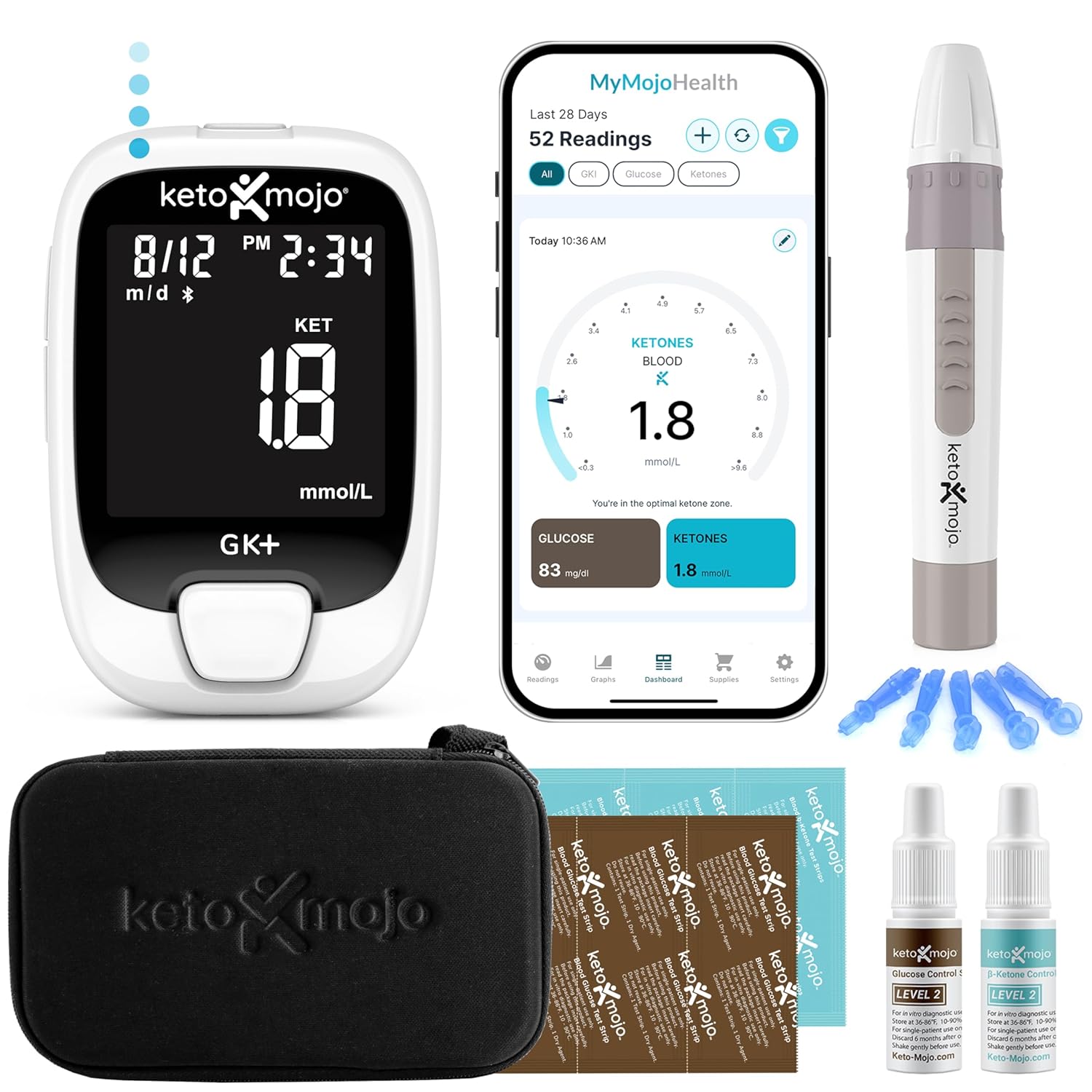
Managing diabetes while eating low-carb has become genuinely mainstream — and for good reason. A very-low-carbohydrate diet can meaningfully flatten blood sugar spikes, reduce insulin requirements, and (for many people with Type 2) improve A1C without adding medication. But here’s the catch that most glucose-only monitors can’t address: once you’re eating low-carb, your body starts producing ketones — natural fuel molecules your liver makes from fat when carbohydrates are scarce. Ketones are not inherently dangerous, but at high levels they become a medical emergency called diabetic ketoacidosis (DKA). Knowing where your ketones land — nutritional range, mild elevation, or danger zone — is information a standard glucose meter simply cannot give you. That’s where dual testing (measuring both blood sugar and blood ketones from the same fingerstick device) becomes a practical, decision-relevant tool. This guide walks through the Keto-Mojo ecosystem specifically, because it’s the dominant consumer-grade platform built for this exact use case.
Why Dual Testing Matters More for Diabetics Than for General Keto Dieters
For someone without diabetes, nutritional ketosis is largely benign. Ketones sit in the 0.5–3.0 mmol/L range, blood sugar stays regulated by intact insulin response, and the two numbers don’t interact dangerously. For a person with Type 1 or insulin-dependent Type 2 diabetes, the dynamic is different in a clinically important way.
The risk window is narrow. A person with Type 1 who is also eating very low-carb can have ketones in the nutritional range (say, 1.2 mmol/L) that are completely fine — and also have ketones at 3.5 mmol/L alongside rising blood glucose that signal early DKA. The glucose number alone doesn’t tell you which scenario you’re in. Per the American Diabetes Association’s Standards of Care in Diabetes 2025, blood ketone testing (beta-hydroxybutyrate, or BHB) is the preferred method for detecting and monitoring DKA, as it measures the primary ketone body directly rather than the lagging urine ketone proxy.
The GKI (Glucose Ketone Index) is a single number that combines both readings into one metabolic snapshot. Healthline’s overview of the glucose ketone index explains it as: glucose (in mmol/L) ÷ ketones (in mmol/L). A GKI below 6 is generally associated with nutritional ketosis; a GKI below 1 is the zone associated with therapeutic ketosis research. Keto-Mojo’s companion app calculates GKI automatically, which is one reason practitioners recommend it over generic dual meters.
For low-carb Type 1s specifically, Diabetes Care has published research noting that while low-carb diets can substantially improve glycemic control in Type 1 diabetes, they also require more frequent monitoring and tighter communication with a care team — precisely because the ketone/glucose relationship becomes clinically active in a way it isn’t for most Type 2s or prediabetics.
The Keto-Mojo Ecosystem: What You’re Actually Buying
Keto-Mojo is not a CGM (continuous glucose monitor — the wearable patch style like Dexcom or Libre). It’s a fingerstick meter system that measures blood glucose and blood ketones from the same small device using separate, differently priced test strips. Here’s the breakdown that actually matters when you’re deciding whether this fits your stack.
By the Numbers
| Item | Approximate Cost (2026, cash-pay) | FSA/HSA Eligible? |
|---|---|---|
| Keto-Mojo GK+ meter (starter kit) | ~$59–$69 | Glucose strips: Yes; Ketone strips: often Yes* |
| Glucose test strips (50-strip box) | ~$19–$22 | Yes |
| Ketone test strips (10-strip box) | ~$19–$22 | Yes (verify with plan) |
| Ketone test strips (50-strip box) | ~$59–$69 | Yes (verify with plan) |
*FSA/HSA eligibility for ketone strips is plan-dependent. Glucose strips are broadly FSA/HSA eligible as a diabetes management supply. Ketone strips used specifically for diabetes monitoring are increasingly accepted, but it’s worth confirming with your FSA administrator before assuming coverage. The IRS does not explicitly exclude ketone strips used for diabetic management from FSA eligibility, but administrator interpretation varies.
The Real Cost-Per-Month Math
This is where practitioners need to run the numbers before recommending Keto-Mojo to a patient panel or purchasing it for personal use.
Scenario A — Type 2 diabetic, low-carb maintenance, testing glucose 2x/day + ketones 1x/day:
- Glucose: 60 strips/month × ~$0.40/strip = $24/month
- Ketones: 30 strips/month × ~$1.25/strip = $37.50/month
- Total: ~$61.50/month fingerstick-only
Scenario B — Type 1 diabetic using a CGM as primary glucose monitor, using Keto-Mojo only for ketone spot-checks (2x/day during illness or suspected DKA risk):
- Glucose strips: minimal (calibration only or backup) — ~$5–$8/month
- Ketones: 60 strips/month × ~$1.25/strip = $75/month
- CGM cost on top (Dexcom G7 or FreeStyle Libre 3 sensors): varies widely by insurance
- Total ketone-only add-on cost: ~$75–$80/month
The ketone strip cost is the line item that surprises people. At roughly $1.25 per strip, frequent ketone testing adds up fast. For a Type 1 using both CGM and dual testing, the total monitoring spend can easily exceed $200/month cash-pay. This is a real tradeoff conversation to have explicitly.
When the Dual-Testing Model Beats a CGM-Only Approach
CGMs are excellent — and for most diabetics reading this, a CGM is likely already part of the stack or under active consideration. But there are specific scenarios where Keto-Mojo fills a gap that no CGM currently addresses.
CGMs don’t measure ketones. As of mid-2026, no FDA-cleared consumer CGM patches blood ketones. Abbott FreeStyle, Dexcom G7 Pro, and the emerging CGM competitors measure interstitial glucose only. If you want blood ketone data, you need a fingerstick ketone meter. Full stop.
Illness protocols for Type 1. The standard sick-day rule for Type 1 diabetics involves ketone testing every 2–4 hours when blood sugar is elevated or the person is symptomatic. A standalone ketone meter handles this, but Keto-Mojo’s simultaneous glucose reading lets you document both values at the same timestamp — cleaner for logging, cleaner for communication with an endocrinologist.
Low-carb optimization without a CGM. For prediabetics or early-stage Type 2s who are managing through diet alone and aren’t yet using a CGM, Keto-Mojo provides both readings from a single device at a lower combined cost than purchasing two separate meters. Virta Health’s published research on nutritional ketosis and Type 2 diabetes management points to ketone levels as a meaningful adherence signal for carbohydrate restriction — essentially, if ketones are present and blood sugar is well-controlled, the dietary approach is working metabolically.
The GKI as a trend metric. For practitioners advising patients in therapeutic ketosis protocols (some neurological, oncology-adjacent, or weight-loss programs use intentional ketosis under supervision), the GKI trend over weeks matters more than any single reading. Keto-Mojo’s app stores GKI history, which makes it easier to show a patient that their metabolic response is shifting.
Tradeoffs and When NOT to Rely on Keto-Mojo
This is where the decision frame gets concrete.
It’s not a CGM replacement. If your primary need is real-time glucose trending — catching a 3 a.m. low, seeing postprandial spikes, or closing the loop with an insulin pump — Keto-Mojo doesn’t solve that. It’s a spot-check device. The Dexcom G7 or FreeStyle Libre 3 ecosystem remains the right primary tool for glucose trend data.
Ketone strip cost is non-trivial at high frequency. At 3+ ketone tests per day, costs approach $110–$135/month in strips alone. For users who simply want to confirm they’re in nutritional ketosis (not monitoring for DKA risk), urine ketone strips cost pennies per strip and may be sufficient — though they’re less accurate and don’t measure BHB directly. Per research published in Nutrition & Metabolism, blood BHB measurement is meaningfully more accurate than urine acetoacetate strips, especially for people who are fat-adapted and excreting fewer ketones renally. But “more accurate” needs to be weighed against cost for each individual’s actual use case.
Insurance generally does not cover ketone strips for routine low-carb monitoring. Medicare and most commercial plans cover ketone testing for diagnosed DKA or specific clinical indications — not for routine nutritional ketosis management. Glucose strips for a second meter may or may not be covered depending on whether a patient already has a CGM. Practitioners advising patients should be explicit: Keto-Mojo is almost always cash-pay for the ketone component.
Bluetooth sync works — but the ecosystem is closed. Keto-Mojo syncs to its own app and integrates with Cronometer and a few other dietary tracking platforms. It does not natively feed data into Dexcom Clarity, LibreView, or Garmin Connect glucose tracking. If a patient’s care team is reviewing CGM data in one portal, the ketone data lives separately. This is a workflow friction point worth flagging.
The Decision Rule: If X, Then Y
Here’s how to map use case to action:
If you have Type 1 diabetes, eat low-carb, and already use a CGM: Add Keto-Mojo for ketone spot-checking — especially during illness, exercise, or unexplained high glucose episodes. Budget ~$40–$75/month for ketone strips as a standing line item. Use glucose strips only as backup. This is the clearest value-add scenario.
If you have Type 2 diabetes, eat very-low-carb, and don’t yet use a CGM: Keto-Mojo as a primary glucose/ketone meter is reasonable and cost-effective versus two separate devices. The ~$60/month all-in fingerstick cost is comparable to or below the cash-pay cost of a CGM subscription. If your glucose is well-controlled and your main interest is metabolic optimization, this is defensible.
If you have prediabetes and are exploring low-carb: The GKI as a tracking tool has real practical value during the early months of dietary change. At lower testing frequency (once daily), the cost is manageable. This is a reasonable entry point before committing to a CGM.
If your primary need is real-time glucose trending, lows prevention, or pump integration: Keto-Mojo is a complement, not a substitute. Anchor your budget on a CGM first; add dual testing only if ketone monitoring is a genuine clinical priority for your situation.
If ketone testing frequency would exceed 3x/day routinely: Run the strip cost math before committing. At that testing cadence, annual spend on ketone strips alone approaches $1,200–$1,600 cash-pay. That number deserves an honest conversation with a care team about whether the data frequency justifies the cost versus quarterly A1C plus periodic spot-check ketone testing.
Dual testing with a device like the Keto-Mojo GK+ occupies a specific, well-defined niche — one that’s genuinely useful for a subset of diabetics eating low-carb, and genuinely oversold to people whose actual monitoring priority is continuous glucose trending. The math is transparent. The tradeoffs are real. Match the tool to the actual clinical question you’re trying to answer, and it earns its place in the kit.