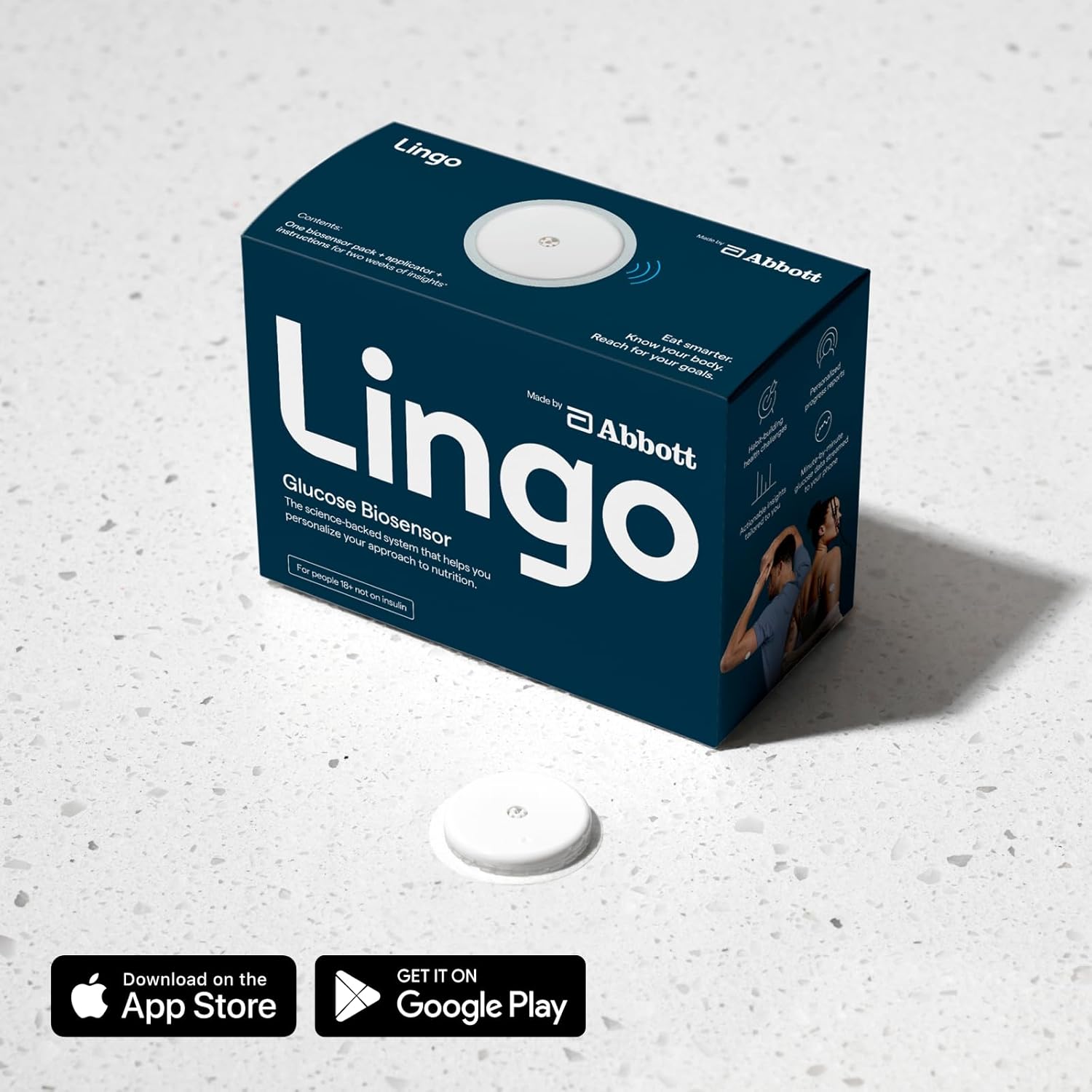
Abbott makes a continuous glucose monitor — a CGM — that sits on the back of your upper arm, reads your glucose every minute without finger sticks, and streams the number straight to your phone. That’s the FreeStyle Libre 3. If you’re managing Type 1 or Type 2 diabetes, this sensor is probably already on your radar. But Abbott also makes a second device called Lingo, aimed at people who don’t have a diabetes diagnosis but still want to see how food, stress, and movement shift their blood sugar in real time. Two products, one brand, very different buyers — and one confusing product page if you don’t know which is which before you start shopping.
This guide maps the full Abbott CGM lineup as of mid-2026: what each sensor does, what it costs on a monthly basis, how insurance and FSA/HSA coverage works, which accessories actually matter, and the tradeoffs you need to name before committing. If you’re recommending these systems to patients, shopping for yourself, or evaluating them for a practice formulary, the decision framework at the end should give you a clear “if X, then Y” answer.
FreeStyle Libre 3: The Clinical Workhorse
The FreeStyle Libre 3 is Abbott’s flagship diabetes CGM. The sensor is roughly the size of two stacked pennies and wears for 14 days. It measures interstitial glucose — the fluid just under your skin, which lags behind blood glucose by a few minutes — and transmits readings every minute to the FreeStyle LibreLink app on iOS or Android. No separate reader required, though Abbott still sells a dedicated reader for patients who prefer it or whose phones aren’t compatible.
The upgrade over Libre 2: The Libre 3 added real-time streaming (versus scan-to-read on Libre 2), a smaller form factor, and a MARD (mean absolute relative difference, the standard accuracy metric for CGMs) of approximately 7.9% per Abbott’s published specifications — a meaningful improvement. The American Diabetes Association’s Standards of Care in Diabetes 2025 (Section 7) formally identifies real-time CGM as the preferred monitoring method for most people using insulin, and the Libre 3 qualifies under that recommendation.
FreeStyle Libre 3 Plus: In late 2024, Abbott received FDA clearance for the Libre 3 Plus, which extends wear to 15 days and adds iCGM designation, meaning it can integrate with automated insulin delivery (AID) systems. Per the FDA’s De Novo and 510(k) clearance summary for this device, the iCGM designation requires demonstrating accuracy within tight pre-specified limits across a broad glucose range. If your patient or practice is evaluating AID compatibility, the Libre 3 Plus is the version to track.
What It Costs Month-to-Month
Here’s the math that matters most:
By the numbers — Libre 3 monthly sensor cost (cash pay, May 2026):
- 2 sensors/month (14-day wear) ×
$75 MSRP per sensor = **$150/month cash pay**- With GoodRx or manufacturer savings program (LibreAssist): can drop to $75–$100/month for commercially insured patients
- Medicare Part B (DME benefit): covered for qualifying insulin-using patients; typical cost-share after deductible is ~$35–$45/month
- FSA/HSA eligible: Yes — sensors, reader, and lancets all qualify
Commercial insurance coverage is uneven. Per CMS’s updated CGM coverage criteria (2025), Medicare coverage requires that the patient uses insulin or has a history of problematic hypoglycemia — “problematic” is a defined term under the DME LCD. Practitioners recommending Libre 3 to non-insulin T2D patients on commercial plans should verify the specific plan’s CGM policy before the patient orders; denial rates remain high for that population despite growing clinical evidence.
Abbott Lingo: The Wellness CGM
Lingo is Abbott’s direct-to-consumer biosensor aimed at people without a diabetes diagnosis — athletes, people with prediabetes, and generally health-curious buyers who want metabolic data without a prescription. The sensor hardware is similar to the Libre platform, but the software experience is completely different. Lingo’s app centers on “glucose zones,” habit nudges, and meal-response patterns rather than the clinical glucose thresholds and alert logic the Libre app uses.
Key distinctions practitioners should understand:
- No prescription required. Lingo is sold over the counter and through Abbott’s direct subscription.
- Not indicated for diabetes management. The Lingo labeling and app explicitly state it is not intended to diagnose or manage diabetes. This matters if a patient asks you whether they can use Lingo instead of Libre to manage their Type 1 — the answer is no.
- Pricing model is subscription-first. As of May 2026, Lingo is available through Abbott’s subscription at approximately $49/month for one sensor every two weeks. That’s a notably lower entry price than Libre 3 cash pay, but it comes with no insurance coverage pathway and no FSA/HSA eligibility under current IRS guidance (because the device is not prescribed for a diagnosed condition).
- No iCGM designation, no AID compatibility. Lingo is not cleared for integration with insulin pumps or closed-loop systems.
Healthline’s 2025 comparison overview of Abbott’s CGM lineup notes that Lingo has generated strong user engagement among the fitness-tracking demographic but has faced criticism for offering limited actionability for people who discover they’re actually in a prediabetic glucose range — at that point, the device’s wellness framing can undersell the urgency.
For practitioners: if a patient presents having used Lingo and showing postprandial spikes above 180 mg/dL regularly, that’s a clinical conversation, not a wellness data point. Lingo’s data can be a useful entry point — just not the endpoint.
Accessories: What’s Worth Buying and What’s Filler
The accessories market around CGMs has exploded, and Abbott’s ecosystem is no exception. Here’s how to triage what actually matters.
Overpatches and Adhesive Extenders
Sensor adhesion is the top reader complaint in online CGM communities, and for good reason. The Libre 3 sensor uses a relatively small adhesive footprint compared to some competitors. In warm weather, after exercise, or for patients with oilier skin, premature sensor detachment before day 14 is common — and a detached sensor is a $75 loss.
Overpatches — thin adhesive patches that ring or cover the sensor to extend wear — are the most practical accessory in this ecosystem. Brands like Skin Tac (a liquid adhesive prep), Simpatch, and Ketto are widely reported by Libre users to significantly reduce early detachment. These are not Abbott-branded products, but they’re compatible and well-documented in patient communities. Overpatches are generally FSA/HSA eligible when purchased as medical supplies.
Abbott does sell its own Libre Sensor Covers (cosmetic covers, not adhesive extenders) — these protect the sensor from snag damage but don’t solve adhesion problems. Worth noting the distinction.
The FreeStyle Libre Reader vs. Phone App
Abbott’s dedicated reader (~$75 retail, FSA/HSA eligible) is worth recommending for:
- Patients without a compatible smartphone
- Elderly patients or those with low digital confidence who find a single-purpose device easier to manage
- Situations where phone access is restricted (some workplaces, facilities)
For most patients, the LibreLink app on a current iPhone or Android covers all functionality. The reader is not required to use the sensor.
Lancets and Backup Strips
Even on a CGM, backup blood glucose strips matter. CGMs require calibration confirmation in certain scenarios — when readings seem off, during rapid glucose change, or per clinical protocol. Abbott’s FreeStyle Precision Neo strips and lancets are FSA/HSA eligible and integrate with the Abbott ecosystem, but they’re interchangeable with any ISO-certified strips and lancets. Cost-conscious patients can use ReliOn or CVS store-brand lancets ($10–$15/box) without any clinical downside.
Third-Party Integrations
One of the Libre 3’s most underappreciated strengths is its integration breadth. The LibreLink Up app allows up to 20 followers to view a patient’s glucose in real-time — a critical feature for parents of children with Type 1 and for caregivers of elderly patients on insulin. This is free, built into the platform, and requires no additional hardware.
For patients in the Garmin ecosystem, Abbott’s connection via Apple Health or compatible third-party apps (like Gluroo) allows Libre 3 data to feed into Garmin fitness watches, though this is not a direct native integration as of May 2026. Practitioners should set expectations: the data flow works, but it involves a few app handoffs rather than a seamless one-tap setup.
Libre 3 vs. Lingo: The Decision Frame
If you’re advising a patient or making a formulary recommendation, here’s the explicit tradeoff map:
| Factor | FreeStyle Libre 3 / 3 Plus | Lingo |
|---|---|---|
| Indicated for diabetes | Yes | No |
| Prescription required | Yes | No |
| Insurance coverage | Yes (varies by plan/Medicare) | No |
| FSA/HSA eligible | Yes | No |
| AID-compatible (3 Plus) | Yes | No |
| Monthly cash cost | ~$75–$150 | ~$49 |
| App focus | Clinical thresholds, alerts | Wellness zones, habits |
| Best for | T1D, insulin-using T2D, prediabetes under clinical management | Non-diagnosed, wellness-motivated, fitness tracking |
If X, then Y — the decision rules:
- If the patient uses insulin: Libre 3 or Libre 3 Plus. Full stop. Lingo is not appropriate for insulin management.
- If the patient is on Medicare and uses insulin: Libre 3 (covered under DME). Confirm they meet the LCD criteria before ordering.
- If the patient has Type 2, no insulin, commercial insurance: Verify plan CGM policy. Many plans still require step-through or prior auth. Libre 3 Plus’s iCGM designation may strengthen the coverage argument with some payers.
- If the patient is prediabetic, motivated, and cash-paying: Lingo is a reasonable entry point at $49/month — but document that if glucose data reveals concerning patterns, clinical escalation is warranted.
- If the patient wants AID integration (pump + CGM closed loop): Only Libre 3 Plus qualifies. Confirm which AID system is in play; interoperability partners vary.
- If the patient is a caregiver managing an elderly parent on insulin: Libre 3 plus LibreLink Up is the strongest fit — remote monitoring capability is built in, and Medicare coverage is likely.
The Abbott ecosystem is genuinely mature and competitive. The Libre 3 holds its own against rival CGMs on accuracy, wear time, and integration depth, per the American Diabetes Association’s 2025 technology standards. Lingo fills a real wellness market gap but should never be positioned as a clinical substitute. Know which device you’re recommending and why — the cost-per-month math and coverage landscape are different enough that conflating them is an avoidable mistake.