If your doctor has ever said “watch your feet carefully,” you already know diabetes can complicate foot health in ways that feel easy to ignore until they aren’t. One of the most common complications is peripheral neuropathy — nerve damage in the feet and lower legs that dulls sensation, making it harder to notice small cuts, blisters, or pressure points before they become serious wounds. About half of all people with diabetes develop some form of peripheral neuropathy over their lifetime, per the American Diabetes Association’s Standards of Care in Diabetes 2025. That numbness, combined with reduced circulation (blood flow that delivers oxygen and healing capacity to injured tissue), means even a sock that fits slightly wrong can cause real harm. This guide breaks down exactly what separates a genuinely protective diabetic sock from a marketing label, which features matter for neuropathy specifically, and how to match sock specs to your situation.
| EDITOR'S PICKSpecial Essentials Diabetic Soc… | Mid-tierDoctor's Select® Diabetic Socks… | Budget pickRevosoxs Diabetic Crew Socks fo… | |
|---|---|---|---|
| Pack count | 12 pairs | 4 pairs | — |
| Material | — | — | Bamboo viscose |
| Moisture-wick | ✓ | — | — |
| Seamless toe | — | — | ✓ |
| Price | $24.99 | $17.99 | $14.89 |
| See on Amazon → | See on Amazon → | See on Amazon → |
Why “Diabetic Sock” Is Both Meaningful and Overused
Walk into any pharmacy and you’ll find a wall of packaging stamped “diabetic sock.” Some of those products deserve the label. Many don’t. The term itself isn’t FDA-regulated — any manufacturer can print it on a package — so the burden falls on the buyer to read the actual spec sheet.
Here’s what a sock engineered for diabetic foot protection actually does differently from a standard athletic or dress sock:
1. Eliminates tight elastic binding at the cuff. Standard socks use a ribbed elastic band to stay up. For someone with compromised circulation, that band can act like a mild tourniquet, reducing blood flow to tissue that’s already under-supplied. Genuine diabetic socks use a non-binding, loose-knit top band that stays up through friction and knit tension rather than compression. Mayo Clinic’s overview of diabetic neuropathy specifically flags constricting footwear and hosiery as a modifiable risk factor.
2. Minimizes or eliminates interior seams. To a healthy foot, a toe seam is a minor annoyance. To a foot with neuropathy — one that can’t reliably signal “this is rubbing” — an interior seam is a slow-motion blister factory. Seamless toe construction, or flat-knit seam placement on the outside of the sock, is a non-negotiable for anyone with reduced sensation.
3. Uses moisture-wicking, antimicrobial fiber. Wet skin breaks down faster and is more susceptible to fungal and bacterial infection. Healthline’s overview of diabetic socks notes that materials like merino wool, bamboo, and moisture-wicking synthetics (CoolMax, Drymax) significantly outperform standard cotton in keeping foot skin dry.
4. Provides cushioned padding in high-friction zones. Extra-thick terry cushioning under the heel and across the ball of the foot reduces shear forces — the sideways friction that creates blisters even when shoes fit correctly.
5. Maintains a non-compressive fit throughout the foot. This is the critical distinction from compression socks (which serve a separate purpose for edema management and should only be worn under clinical guidance when arterial disease is present).
The Neuropathy-Specific Decision Frame
Not all diabetic patients need the same sock. The relevant variables are severity of nerve damage, presence of peripheral arterial disease (PAD), and how active the wearer is. Here’s how to think about the tradeoffs:
| Situation | Primary Risk | Sock Priority |
|---|---|---|
| Mild sensory neuropathy, active lifestyle | Friction blisters, moisture | Seamless toe + heavy cushion + moisture-wick |
| Moderate neuropathy, sedentary | Pressure ulcers at bony prominences | Extra-thick padding, extra-wide fit |
| Neuropathy + PAD | Impaired healing | Non-binding cuff, no compression, breathable fiber |
| Neuropathy + edema (swelling) | Both compression and wound risk | Requires clinical guidance — graduated compression only with ABI testing |
Per the National Institutes of Health review on peripheral arterial disease and diabetic foot published in the Journal of Diabetes Science and Technology, PAD and neuropathy co-occur in a significant subset of patients, and the combination creates the highest risk for ulceration and amputation. That’s why recommending compression socks to a patient with undiagnosed PAD — a common well-intentioned mistake — can actually cut off blood flow to tissue that’s already ischemic.
The clear rule: If PAD is present or suspected (cold feet, hair loss on lower legs, weak pedal pulse), default to non-compressive diabetic socks only and flag the patient for ankle-brachial index testing before any compression hosiery is introduced.
By the Numbers
- 50% of people with diabetes develop peripheral neuropathy at some point (ADA Standards of Care, 2025)
- ~15–25% of diabetic patients will develop a foot ulcer in their lifetime (Harvard Health Publishing, Diabetes and Your Feet)
- 80% of lower-extremity amputations in people with diabetes are preceded by a foot ulcer — the majority of which are preventable (NCBI / Journal of Diabetes Science and Technology)
- Sock replacement cycle at-risk patients should target: every 3–6 months for daily-wear pairs, as cushioning compresses over time and seams begin to fray inward
What the Best Diabetic Socks Actually Look Like: Product Landscape
The market has consolidated around a few brands that consistently earn high marks from owners, podiatrists, and diabetes educators. Here’s how the major players compare on the specs that matter.
Viasox — Design-Forward, Clinically Sound
Viasox has built a following among lifestyle-conscious buyers who don’t want to choose between clinical function and looking put-together. Owners consistently report that the non-binding cuff actually stays up (a common failure point in cheaper diabetic socks) and that the seamless toe construction eliminates the “ridge” problem that causes blisters. The brand offers both standard and extra-wide sizing, which matters for patients with edema or wide feet from Charcot deformity. Viasox is an FSA/HSA-eligible product — worth flagging for caregivers managing purchases for aging parents or children with Type 1.
Orthofeet Diabetic Socks — Therapeutic Ecosystem Play
Orthofeet is primarily known for therapeutic footwear, but their sock line is worth considering specifically for buyers already in the Orthofeet shoe ecosystem. The socks are designed to complement the brand’s extra-depth shoes, with padding placement calibrated to Orthofeet’s last geometry. If a patient is already wearing Orthofeet shoes, the brand-matched sock reduces the risk of unintentional pressure misalignment between sock padding and shoe footbed. Reviewers note the merino wool options offer superior temperature regulation for patients who experience the “burning cold” sensation common in advanced neuropathy.
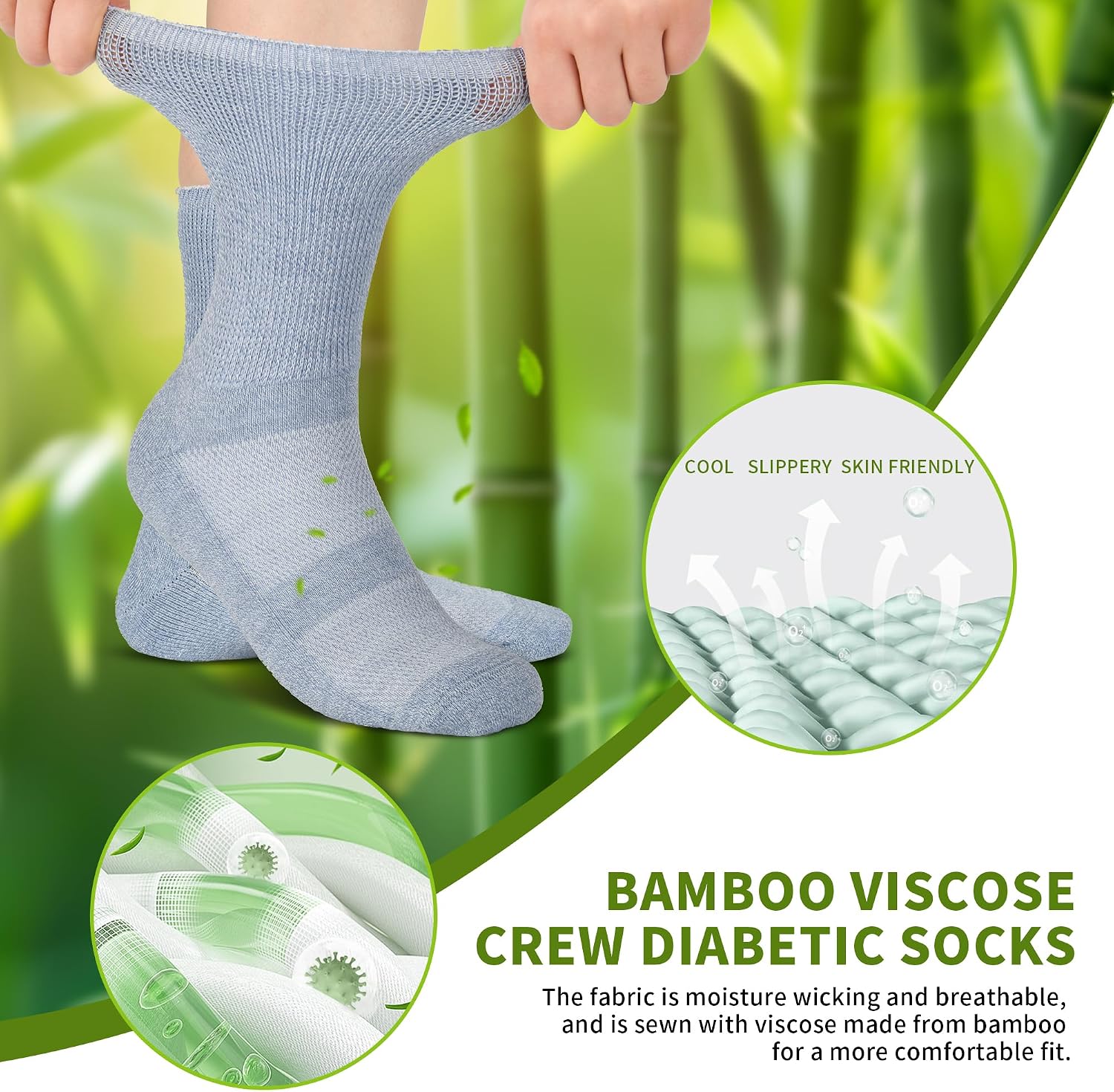
Budget Tier: Yomandamor and Similar Bamboo-Blend Options
For buyers managing cost — or caregivers buying in bulk for a parent who burns through socks quickly — bamboo-blend diabetic socks from brands like Yomandamor represent a legitimate middle ground. Bamboo fiber is naturally moisture-wicking and antimicrobial, and the price point (typically $15–$25 for a 5–6 pack) makes consistent replacement financially sustainable. The tradeoff is durability and cushioning depth: across aggregated buyer reviews, bamboo-blend options tend to thin out faster than merino wool or synthetic-reinforced options, meaning the 3-month replacement cycle applies more aggressively here.
FSA/HSA note: Diabetic socks are generally FSA/HSA eligible as a medical expense when purchased for a diagnosed condition. Keep receipts and confirm your plan administrator’s documentation requirements — some require a Letter of Medical Necessity for sock purchases.
Fit Variables Practitioners Often Underweight
Length Matters More Than It Looks
Crew-length socks (mid-calf) are the default recommendation for neuropathy patients — they protect the lower leg from minor abrasions without the compression risk of knee-highs. Quarter-length socks leave the Achilles and lower calf exposed to shoe-edge rubbing, which is a higher-risk area than most patients realize. For patients who wear compression sleeves or orthotic bracing, sock length needs to be coordinated with the brace interface to avoid ridge formation.
Width and Toe-Box Volume
A sock that’s even slightly too narrow in the toe box creates its own pressure point, negating the seam-free benefit. For patients with hammertoe deformity, bunions, or Charcot foot remodeling, extra-wide and extra-deep toe-box socks are not optional — they’re the baseline. Several brands (Orthofeet, Viasox) now offer true extended-width sizing rather than simply stretching a standard pattern.
Seasonal Adjustment
Neuropathy affects thermoregulation. Many patients report that their feet feel cold even in warm environments (a circulation-mediated symptom) while also being unable to detect when feet are actually overheating inside a shoe. Year-round, the priority is moisture management. In colder months, merino wool offers warmth without the moisture-retention problem of standard wool. In summer, thin moisture-wicking synthetics reduce maceration risk in patients prone to hyperhidrosis (excessive sweating).
The Decision Rule
Here’s the straightforward framework for matching sock spec to patient situation:
If neuropathy is mild to moderate + no PAD + active lifestyle → Seamless toe, heavy cushion, moisture-wicking synthetic or bamboo blend, crew length. Replace every 3 months. Viasox or equivalent mid-range brand.
If neuropathy is moderate to severe + sedentary + wide feet or deformity → Extra-wide seamless construction, maximum heel/ball cushioning, non-binding cuff. Orthofeet brand-matched if already in Orthofeet shoes. Replace every 3 months or sooner if cushioning flattens.
If PAD is confirmed or suspected → Non-compressive only, no compression socks, breathable natural fiber (merino or bamboo), podiatry referral for comprehensive foot assessment before finalizing any sock or shoe recommendation.
If budget is the binding constraint → Bamboo-blend bulk packs are clinically acceptable; just tighten the replacement cycle to every 8–10 weeks and ensure the toe construction is truly seamless (check the interior, not just the marketing label).
The underlying logic across all tiers is the same: the foot that can’t feel danger depends entirely on the sock to absorb it. That’s not a marketing claim — it’s the clinical reality that Harvard Health Publishing, the ADA, and every podiatrist who’s treated a preventable ulcer will confirm. The sock is the first line of defense. Make sure it’s actually doing the job.