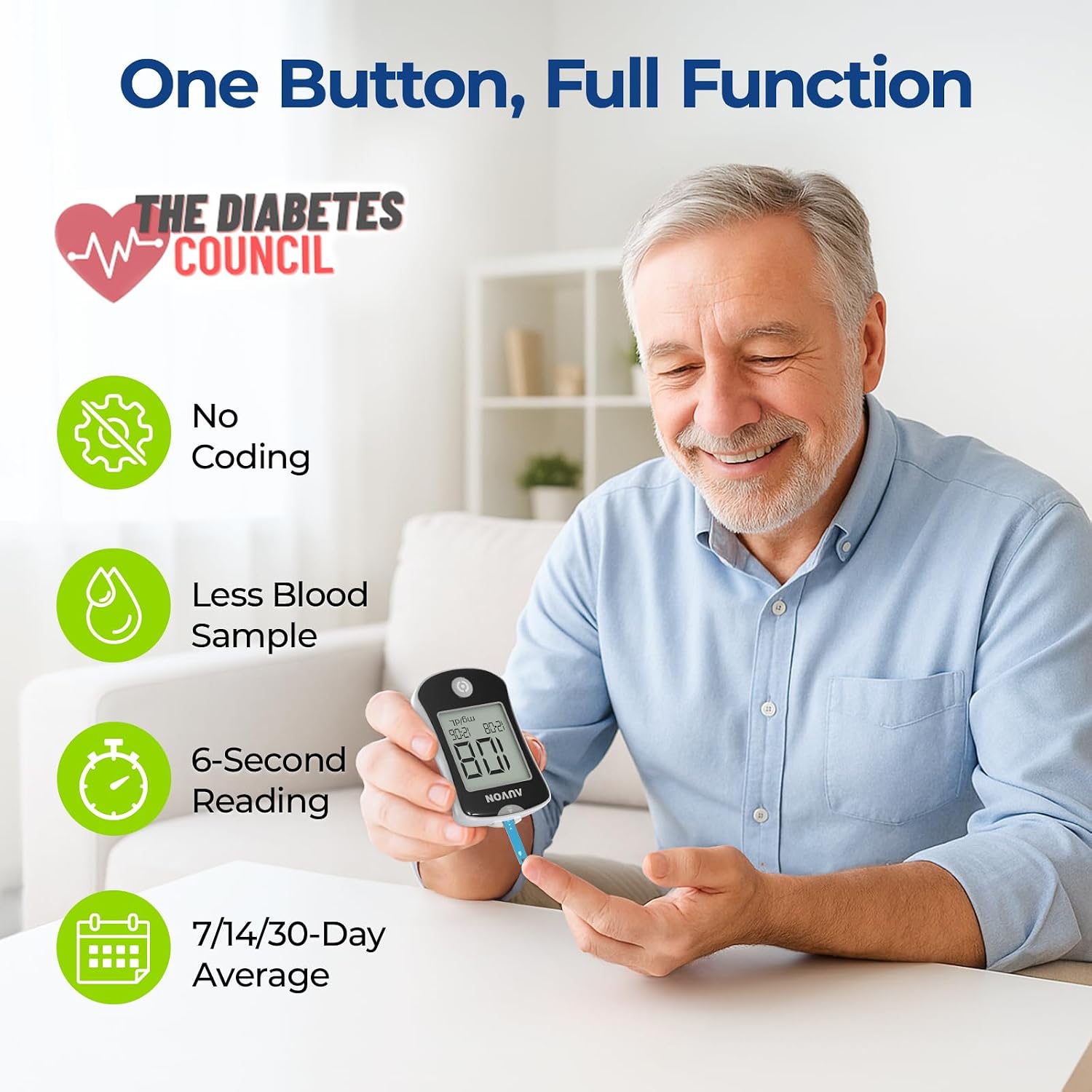
If you’ve ever stared at two glucose readings taken thirty seconds apart — one says 98, the other says 127 — you’ve already stumbled into the central question of budget meter buying. A glucose meter (also called a blood glucose monitor or BGM) is a small handheld device that reads the sugar level in a drop of your blood, usually from a fingertip. The number it gives you — expressed in mg/dL in the United States — is what you use to decide whether to eat, dose insulin, or call your doctor. So accuracy isn’t a nerdy spec-sheet detail. It’s the whole game. This article digs into what budget meters under roughly $30 actually deliver, based on what thousands of real owners report, and gives you a clear decision framework for whether one of these devices belongs in your kit.
| EDITOR'S PICKCareSens N Blood Glucose Monito… | Mid-tierAUVON Blood Glucose Monitor Kit… | Budget pickAUVON Blood Glucose Monitor Kit | |
|---|---|---|---|
| Test strips | 100 | 100 | 50 |
| Lancets | 100 | 100 | 50 |
| Coding | — | No coding | No coding |
| Control solution | ✓ | — | — |
| Case included | ✓ | — | — |
| Price | $31.99 | $25.99 | $19.98 |
| See on Amazon → | See on Amazon → | See on Amazon → |
The FDA Accuracy Standard: What “Accurate Enough” Actually Means on Paper
Before getting into specific models, it helps to know the regulatory baseline. The FDA requires that cleared blood glucose monitors meet ISO 15197:2013 accuracy criteria: 95% of readings must fall within ±15 mg/dL of a reference value for glucose levels below 100 mg/dL, and within ±15% for readings at or above 100 mg/dL. Per the FDA’s guidance documentation on blood glucose monitoring devices, a meter that clears 510(k) review has demonstrated it can hit that standard under controlled lab conditions.
The operative phrase is under controlled lab conditions. Real-world factors — altitude, temperature, humidity, hematocrit levels, strip age, finger prep, and blood volume — can all push a reading outside that corridor. A meter that passed FDA clearance is not guaranteed to hit ±15% on every single reading in your kitchen.
The American Diabetes Association’s Standards of Care in Diabetes (2025 edition, published in Diabetes Care) reinforces this: it recommends that people using insulin use meters with the highest accuracy available, and flags that even cleared devices vary in real-world performance. That’s not a condemnation of budget meters — it’s context that matters enormously when you’re choosing one.
What “Ballpark Accurate” Actually Means in Practice
Reviewers of the AUVON DS-W models have introduced a phrase into the budget-meter conversation that deserves unpacking: ballpark accurate. One owner gave the device five stars specifically after reframing what they were asking of it — noting the meter wasn’t engineered for pinpoint precision, but for tracking trends and catching highs and lows.
That reframe is doing a lot of work, and it’s worth sitting with. Here’s what “ballpark” tends to mean in aggregated owner reports:
- Directionally correct. The meter reliably tells you whether you’re low, in range, or high. It won’t call a 240 mg/dL a 90.
- Inconsistent on exact numbers. Back-to-back readings on the same fingerstick may vary by 10–20 mg/dL without any meter malfunction.
- Less reliable at extremes. Owners report that readings at the low end (under 70 mg/dL) and the high end (over 250 mg/dL) show more spread than mid-range readings.
The Glucoracy meter surfaces the most concerning version of this pattern. Owners specifically report wide variance on sequential tests — one reviewer documented readings of 41 mg/dL and then a normal value on the same drop of blood. That kind of swing isn’t a trend-tracking quirk. It’s a clinical problem, particularly for insulin users. Healthline’s overview of blood sugar monitoring notes that any reading below 70 mg/dL should be treated as hypoglycemia and acted on — a false low of 41 when you’re actually in range could trigger unnecessary treatment; a true low that reads normal is far more dangerous.
Where Budget Meters Actually Earn Their Stars
Not every sub-$30 device earns the “ballpark” label as a consolation prize. Two models stand out in aggregated owner reports for different reasons.
CareSens N owners consistently describe readings that tracked closely to their previous meters — with multiple reviewers specifically noting it matched their CareTouch results within a clinically acceptable margin. For a budget device, that kind of cross-meter consistency is meaningful signal. It suggests the strip chemistry is performing reliably, not just occasionally.
Metene TD-4116 earns points from a different angle: it includes a control solution in the kit. Control solution (a pre-mixed liquid with a known glucose concentration) lets you verify that your meter and strips are working together correctly before you ever poke your finger. Skeptical first-time buyers report that running a control check before their first real reading significantly increased their confidence in the device. That’s a legitimate trust-building feature — and not every budget kit includes it.
MicroTech reviewers consistently praise a different convenience feature: auto-on strip insertion, meaning the meter powers up the moment you insert a test strip. No button press, no waiting. For users with dexterity challenges or those testing frequently throughout the day, that friction reduction adds up.
By the Numbers: Budget Meter Tradeoffs at a Glance
| Meter | Owner-Reported Strength | Owner-Reported Concern | Control Solution Included? |
|---|---|---|---|
| AUVON DS-W | Trend tracking, affordable strips | Expects reframed accuracy standard | Varies by kit |
| Glucoracy | Low upfront cost | Wide back-to-back variance reported | Not consistently |
| CareSens N | Cross-meter consistency praised | Less name recognition | Some kits |
| Metene TD-4116 | Control solution builds trust | Mid-tier strip cost | Yes |
| MicroTech | Auto-on insertion, convenience | Smaller owner review base | Some kits |
The Decision Frame: When Cheap Is Fine, When It Isn’t
This is where the practitioner read matters. Budget meters are not uniformly bad or uniformly good. The right question is: what is this meter being used for, and what are the consequences of a reading that’s off by 20%?
If X, then Y — the decision rules:
If you take mealtime insulin, a budget meter is a meaningful risk. Insulin dosing math is sensitive. A reading of 180 mg/dL that’s actually 145 mg/dL could lead to a correction dose that drives you into hypoglycemia. The ADA’s 2025 Standards of Care explicitly emphasizes highest-accuracy devices for insulin users. In this scenario, step up to a mid-tier meter — Contour Next, OneTouch Verio, or Accu-Chek Guide — where owner-reported and published accuracy data are significantly stronger.
If you’re managing Type 2 with diet and oral medications only, a budget meter for trend tracking is defensible. You’re watching patterns — is your fasting glucose trending down? Does that meal spike you more than expected? A ±15–20 mg/dL variance doesn’t invalidate trend data. Here, a CareSens N or Metene TD-4116 offers real value.
If you’re a caregiver buying a backup meter for travel or secondary use, a budget meter makes sense as a redundancy device — not a primary clinical tool.
If you’re a diabetes educator or practice recommending to patients, budget meters are appropriate for newly diagnosed patients on oral meds who need to start monitoring habits before investing in a premium ecosystem. Set expectations explicitly at the point of recommendation: explain the ±15% standard, teach control solution use, and build in a follow-up check-in.
One practical note: strip cost per month often matters more than meter purchase price. A “free” or $20 meter with $1.00-per-strip economics costs $30–$60/month at once-daily testing. Run the math before recommending or buying.
Frequently Asked Questions
1. If I test twice in a row and get different numbers, is my meter broken?
Probably not broken — but the variance tells you something. Some spread between back-to-back readings is normal; even hospital-grade meters have a tolerance range. A difference of 5–10 mg/dL is usually within expected variation. A swing of 30+ mg/dL on the same fingerstick, as some Glucoracy owners report, is worth investigating: check strip expiration, ensure the test site was clean and dry, and run a control solution check if your kit includes one. If wide variance persists across a fresh vial of strips, contact the manufacturer.
2. Do all these kits include a control solution to check meter accuracy?
No — and this matters. Metene TD-4116 is specifically noted by owners for including control solution. Other budget kits vary; some include it, some don’t, and some require you to buy the brand’s solution separately. Check the product listing carefully before buying, especially if you’re a first-time user or recommending the device to a patient who will need to self-verify.
3. How do budget meters compare to what my doctor’s office uses?
Doctor’s offices typically use point-of-care analyzers that are laboratory-grade or near-laboratory-grade — the FDA holds them to tighter accuracy standards than consumer meters. Per FDA guidance on blood glucose monitoring devices, consumer BGMs are cleared to ±15% (at levels ≥100 mg/dL), while professional-use analyzers often target tighter corridors. Budget consumer meters are several steps removed from clinical analyzers in both precision and quality control.
4. Is a $25 meter accurate enough if I take insulin?
This is the hardest question, and the honest answer is: it’s a meaningful risk. Budget meters can technically clear FDA standards on paper, but owner reports — particularly from Glucoracy users noting wide sequential variance — suggest real-world performance varies. If you dose insulin based on your readings, the ADA recommends the highest accuracy available. A $25 meter is an acceptable emergency backup. It’s not the tool to build an insulin dosing regimen around.
5. What does it mean when a reviewer says a meter is “ballpark” accurate?
It means the meter reliably catches directional signal — high, low, or in range — but shouldn’t be trusted for precise numeric values. AUVON DS-W reviewers coined this framing explicitly. For someone managing with lifestyle changes and no medication, ballpark is often sufficient. For anyone doing insulin math, “ballpark” is a red flag.
6. Can I trust a no-name brand meter as much as Accu-Chek or OneTouch?
Trust should be earned by owner-reported consistency, not brand recognition alone. CareSens N, despite being less familiar to American buyers, earns strong cross-meter consistency reports. Meanwhile, some well-marketed budget devices underperform. That said, Accu-Chek and OneTouch have decades of published accuracy data, robust strip supply chains, and strong caregiver support ecosystems that no-name brands simply don’t match. For primary clinical use, especially insulin management, the established brands carry less uncertainty.
Accuracy claims in this article reflect owner-reported experiences from aggregated consumer reviews and are not lab-verified findings. Always confirm any meter’s suitability for your specific management plan with your diabetes care team.