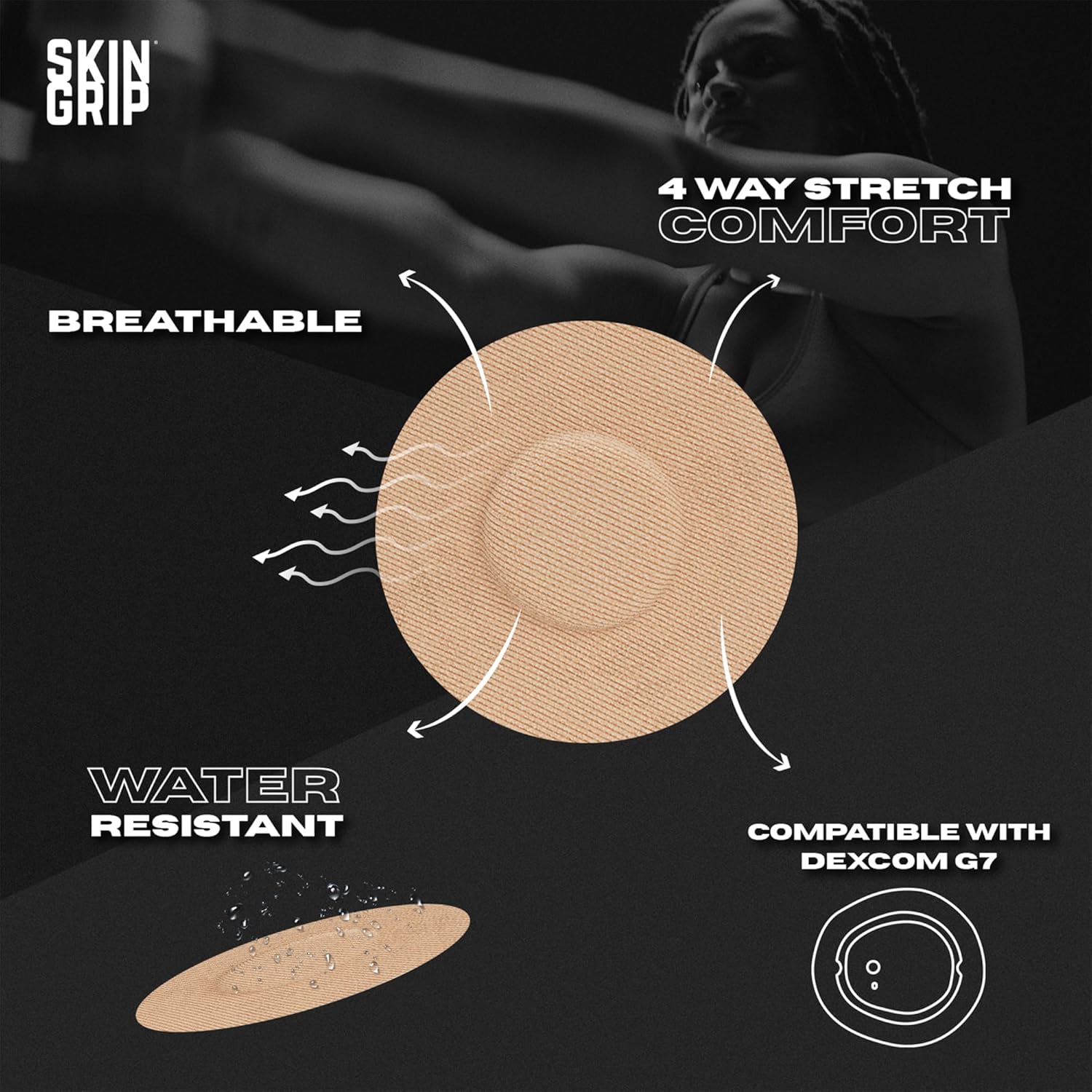
Your continuous glucose monitor — a CGM, the small wearable sensor that tracks your blood sugar in real time without finger-stick tests every few hours — is only useful when it’s actually stuck to your body. Most CGM sensors are designed to wear for 10 to 15 days straight. That’s a lot of showers, workouts, hot days, and hours of sleep between you and a fresh sensor. And for a meaningful slice of wearers, the adhesive backing that holds the sensor to skin gives up well before the sensor’s data-collecting life is done. When that happens, you lose glucose readings, waste an expensive sensor, and — depending on your CGM system — may have to recalibrate or restart entirely.
The fix most experienced wearers land on is an overpatch: a thin, adhesive fabric ring or sheet that goes over the sensor like a second layer of tape, reinforcing the original adhesive. Overpatches sound simple. The buying decision, though, is surprisingly nuanced — the wrong size, material, or adhesive strength can irritate skin, block app scanning, or fail just as fast as the original. This guide is built for wearers and caregivers who already know what a CGM is and are now ready to make a smart, durable choice about adhesion.
| EDITOR'S PICKSkin Grip Adhesive Patches Comp… | Mid-tierTorbot IM074407W314832 Group In… | Budget pickOnida Dexcom G7 Adhesive Patche… | |
|---|---|---|---|
| Pack count | 20 | 50 | 20 |
| Waterproof | ✓ | — | ✓ |
| Wear time | 10-15 days | — | — |
| Form | Patch | Liquid wipe | Patch |
| Compatible | Dexcom G7, Stelo | — | Dexcom G7, Stelo |
| Color | Tan | — | — |
| Price | $25.99 | $17.98 | $15.99 |
| See on Amazon → | See on Amazon → | See on Amazon → |
Why CGM Sensors Lose Adhesion — and Why It Matters More for Active Wearers
The original adhesive on Dexcom G7, Abbott FreeStyle Libre 3, and similar sensors is a medical-grade hydrocolloid or acrylic designed to handle normal daily moisture. Per Dexcom’s G7 User Guide, the sensor is rated water-resistant to 8 feet for 24 hours — but “water-resistant” refers to the electronics, not a guarantee that the adhesive survives a long swim or a two-hour run in August humidity.
Sweat is the primary enemy. Perspiration chemically breaks down acrylic adhesives from the edges inward, a process that accelerates with heat. Wearers in diabetes online communities consistently report that sensors placed on the upper arm — the most common site for Libre 3 and Dexcom G7 — are especially vulnerable during upper-body strength training, where the skin stretches, flexes, and sweats simultaneously. Swimmers report full sensor detachment within 48 hours without reinforcement, even when following manufacturer prep instructions.
Skin prep matters, too. Healthline’s 2024 medical review on CGM sensor adhesion notes that applying a sensor over moisturizer, sunscreen, or incompletely dried skin dramatically shortens adhesive life. Wearers with oily skin or those in high-humidity climates face a compounding challenge.
The clinical stakes are real. The American Diabetes Association’s 2025 Standards of Care (Diabetes Care, Vol. 48, Supplement 1) treats CGM time-in-range data as a primary management metric. A sensor that fails on day 5 of a 14-day wear cycle means roughly 64 hours of missing glucose trend data — the kind of gap that obscures overnight patterns and post-exercise dips that a finger-stick test every few hours would never catch anyway.
The Overpatch Landscape: What’s Actually on the Market
The overpatch market has matured significantly since 2022. You’re no longer choosing between one generic beige ring and bare skin. Here’s how the product field currently segments:
Brand-specific die-cut patches are pre-sized to fit a specific sensor footprint — Dexcom G7, Libre 3, Libre 2 Plus, or Omnipod 5. They leave the sensor’s NFC scanning window or transmitter face fully exposed, which matters for Libre users who scan with a phone or reader. Dexcom’s own Dexcom Sensor Tape (sold separately, FSA-eligible) and Abbott-licensed third-party options fall here. Reviewers consistently call the die-cut format the easiest to apply correctly.
Universal flexible film patches are oversized transparent polyurethane sheets you trim or place over any sensor. Tegaderm and similar medical-grade film dressings — originally designed for IV site protection — have been adopted widely by CGM wearers. The FDA’s device classification database categorizes wound-care film dressings separately from CGM accessories, which affects FSA eligibility: film dressings are generally FSA-eligible as a wound care supply, but confirm with your plan administrator. Wearers report strong adhesion with film, but the lack of a pre-cut window can interfere with NFC scanning on Libre devices unless you trim carefully.
Fabric/cotton-blend rings are the breathability play. Wearers with sensitive skin or contact dermatitis reactions to acrylic adhesives often report better outcomes with woven fabric patches, which allow moisture to escape rather than trapping sweat under the patch. The tradeoff: fabric patches generally don’t outlast a full 14-day Dexcom G7 wear in high-sweat conditions without reapplication.
Skin-tac and liquid adhesive barriers aren’t patches at all — they’re applied to the skin before sensor placement, creating a tackier surface. GrifGrips Skin Tac wipes and Unisolve-adjacent products are frequently mentioned in diabetes management communities as a prep layer rather than an overpatch substitute. They’re most effective as a system: prep skin with a barrier, apply the sensor, reinforce with a die-cut patch.
By the Numbers
| Sensor | Rated Wear (Days) | Common Real-World Dropout (Active Wearers, No Overpatch) | Avg. Sensor Cost (Cash Pay, 2026) |
|---|---|---|---|
| Dexcom G7 | 10 | Day 4–7 (sweat-heavy users) | ~$35–$45/sensor |
| Abbott FreeStyle Libre 3 | 14 | Day 5–9 (swimmers / high humidity) | ~$25–$35/sensor |
| Libre 3 Plus | 15 | Day 6–10 (similar profile) | ~$28–$38/sensor |
Cash-pay estimates based on aggregated pharmacy pricing as of Q2 2026. Insurance and CGM subscription programs alter the per-sensor out-of-pocket significantly.
A dropped Dexcom G7 sensor on day 5 costs you roughly $20–$25 in wasted wear. A 10-pack of quality overpatches runs $12–$20. The math for active wearers is not close.
How to Match an Overpatch to Your Actual Situation
This is where most buyers go wrong: they buy on brand recognition rather than use-case fit. Work through these decision variables before you add anything to cart.
Variable 1: Sensor model and scanning method
If you use FreeStyle Libre 3 or Libre 2 Plus and scan with a phone, your overpatch must leave the NFC window exposed or use NFC-transparent film. Wearers report that thick fabric patches placed directly over the Libre sensor’s face block NFC scans reliably. Die-cut Libre-specific patches solve this cleanly. Dexcom G7 and G6 transmit via Bluetooth continuously — NFC clearance isn’t a concern, giving you more patch format flexibility.
Variable 2: Sweat volume and activity type
Swimmers and water sports participants: full-coverage waterproof film (Tegaderm or equivalent) applied with zero air bubbles is the standard recommendation across diabetes care specialist communities. Fabric breathes but saturates; film doesn’t. For dryland athletes (runners, cyclists, gym wearers) in moderate climates, a die-cut fabric patch combined with skin-tac prep usually gets you through a full wear cycle. Abbott Diabetes Care’s FreeStyle Libre 3 Instructions for Use explicitly recommends against direct water pressure on the sensor, so overpatch reinforcement is doubly important for aquatic activities.
Variable 3: Skin sensitivity
Contact dermatitis from CGM adhesives is a documented and underreported problem. Healthline’s CGM adhesion review notes that patch-related reactions are one of the top reasons wearers abandon CGM systems in the first year. If you or a patient has experienced redness, blistering, or persistent itching under a sensor or patch, the priority shifts: look for patches made with hypoallergenic, latex-free fabric adhesive, and consider placing a thin hydrocolloid barrier (like a Tegaderm Thin Hydrocolloid strip) between skin and sensor before applying the sensor itself. This is off-label use, but it’s widely discussed in patient education settings and among certified diabetes care specialists.
Variable 4: FSA/HSA eligibility
FSA/HSA eligibility for overpatches is a genuinely murky area. Patches marketed specifically as CGM accessories (branded as “Dexcom sensor tape” or “CGM overpatch”) are generally treated as durable medical equipment accessories and are FSA-eligible at most administrators. Generic wound-care films (Tegaderm boxes purchased at a pharmacy) are FSA-eligible as wound care supplies. Cosmetic or fashion-forward patches marketed primarily as a style accessory may not qualify — check your plan’s eligible expenses list. When in doubt, a letter of medical necessity from your endocrinologist or certified diabetes care specialist can support an FSA reimbursement claim.
Decision Framework: If X, Then Y
Rather than a ranked list, here’s a direct decision map based on the most common active-wearer scenarios:
If you swim more than twice a week with your sensor on: Use full-coverage waterproof polyurethane film (Tegaderm 1626W or equivalent medical film dressing). Trim a window for Libre NFC scanning. Reapply if edges lift after day 7. FSA-eligible as wound care.
If you’re a dryland athlete with normal skin and no sensitivity history: Start with a brand-matched die-cut fabric patch (Dexcom Sensor Tape for G7, a Libre-specific die-cut for Libre 3). Add skin-tac prep wipes for wear cycles longer than 10 days or in summer months. Most cost-efficient entry point.
If you have a history of skin reactions to CGM or patch adhesives: Prioritize hypoallergenic fabric patches, and layer a hydrocolloid skin barrier beneath the sensor. Document the reaction and loop in your care team — persistent adhesive dermatitis occasionally warrants a sensor site change or CGM system reconsideration.
If you’re a caregiver managing CGM for a child with Type 1: Children’s skin is more sensitive and their activity level unpredictable. Wearers and caregivers of pediatric patients on Omnipod 5 or Dexcom G7 consistently recommend fabric patches over film for daily school use (more forgiving on sensitive skin, easier to check edges), switching to full film coverage for pool days. Per Insulet’s Omnipod 5 User Guide, the pod itself has a separate adhesion system — but paired CGM sensors require the same overpatch logic.
If you’re a diabetes educator or CDCES recommending overpatches to a patient panel: The practical recommendation hierarchy that holds up across patient populations is: skin prep first (alcohol wipe, fully dry), optional hydrocolloid barrier for sensitive skin, sensor per manufacturer instructions, then die-cut overpatch matched to the sensor model. Full film coverage for aquatic patients. Revisit adhesion at every follow-up for new CGM starters — dropout before 30 days is the leading early abandonment trigger you can actually address without changing therapy.
One Last Thing Before You Buy
Overpatches are a small purchase with a disproportionate impact on CGM data quality and wearer experience. Sensor dropout mid-wear isn’t just inconvenient — it creates real gaps in the time-in-range data that your care team uses to make medication and lifestyle recommendations. Per the ADA’s 2025 Standards of Care, CGM effectiveness is directly tied to consistent wear. A $15 pack of patches protecting a $35 sensor is one of the better cost-per-outcome math problems in diabetes management.
Start with one format matched to your use case above, use two or three sensors’ worth of wear to evaluate, and adjust from there. This is an area where the community’s accumulated real-world experience — aggregated across thousands of wearers in every climate and activity level — is your most reliable guide. The manufacturers have tested the sensors; active wearers have tested everything that keeps them on.