If you’ve ever watched a $90 CGM sensor — that’s a continuous glucose monitor, a small wearable device that tracks your blood sugar around the clock without finger sticks — start peeling off your arm on day four of a fourteen-day wear window, you understand what this article is about. The sensor itself is brilliant technology. The adhesive holding it to your skin is frequently not. Heat, sweat, body oils, swimming, and even the oils from a single nervous hand-swipe can all shorten a sensor’s grip. The good news: there’s a well-established, layered solution. A prep wipe clears the landing zone, a liquid adhesive like Skin Tac creates a tackier surface, and an overpatch — a thin, breathable bandage that frames or covers the sensor — locks everything in place. This guide breaks down how each layer works, when you need all three, and how to choose between the brands that actually perform under real conditions.
Why CGM Adhesion Fails in the First Place
The FDA’s device overview for continuous glucose monitors notes that sensors are designed to adhere to a range of skin types under normal daily activity — but that specification was not written with a South Florida August in mind, or a triathlete, or an eighty-year-old with fragile, crepey skin.
There are three common failure modes, and diagnosing yours determines which part of the system to reinforce.
Failure Mode 1: Contaminated skin surface. Body oils, lotion residue, and sweat create a barrier between the sensor’s factory adhesive and your skin. The sensor sticks fine on application day, then progressively loosens as the oils migrate to the interface. This is the most common cause of early lift on abdomens, where moisturizer use is frequent.
Failure Mode 2: Edge lift from movement or water. The sensor’s adhesive patch has a perimeter. Every time you move your arm, flex your abdomen, or towel off after a shower, mechanical stress concentrates at the edges. Once an edge lifts, moisture and debris get underneath — it’s over. This is the dominant complaint for arm-mounted sensors (Dexcom G7, Abbott FreeStyle Libre 3, and the Stelo OTC sensor) because arm skin moves constantly.
Failure Mode 3: Skin-type mismatch. Very dry or very oily skin, older skin with reduced elasticity, and skin prone to sweating all create conditions where standard factory adhesive underperforms. Across aggregated reviews, users in humid climates — particularly Gulf Coast and Southeast states — report sensor failures at a meaningfully higher rate than the manufacturer-rated wear window would predict. One reviewer, describing their Stelo sensor failing repeatedly in South Florida heat, noted they wrote their first-ever product review specifically because the frustration was severe enough to motivate action.
Layer One: Prep Wipes — The Step Most People Skip
A prep wipe is an alcohol- or IV-prep-type wipe used on the skin before sensor placement. Its job is surface decontamination: strip oils, clear lotion residue, and dry the skin so the factory adhesive — or any additional adhesive you apply — bonds to actual skin rather than a greasy film.
The protocol matters as much as the product. Per Dexcom’s own G7 User Guide, users should clean the application site with an alcohol wipe, let it air-dry completely, and avoid touching the area before placing the sensor. That drying step is where most people fail — dabbing the skin dry or applying the sensor while still damp creates a moisture trap. Thirty to sixty seconds of air-dry time is the minimum.
IV prep wipes vs. standard alcohol wipes: Standard 70% isopropyl alcohol wipes clean the surface but leave no residue. IV prep wipes — the same category used before IV catheter placement in clinical settings — often contain a small amount of adhesive-compatible residue that slightly increases tackiness. Many experienced CGM users specifically seek out IV prep wipes rather than standard alcohol swabs. For users with sensitive skin, the choice of wipe matters: some prep products contain benzalkonium chloride or other antiseptics that can irritate reactive skin with repeated daily use.
Used in isolation, a prep wipe alone solves Failure Mode 1. It will not rescue a sensor in high-sweat or aquatic conditions. Think of it as the floor, not the ceiling.
Layer Two: Skin Tac — The Physician-Recommended Middle Layer
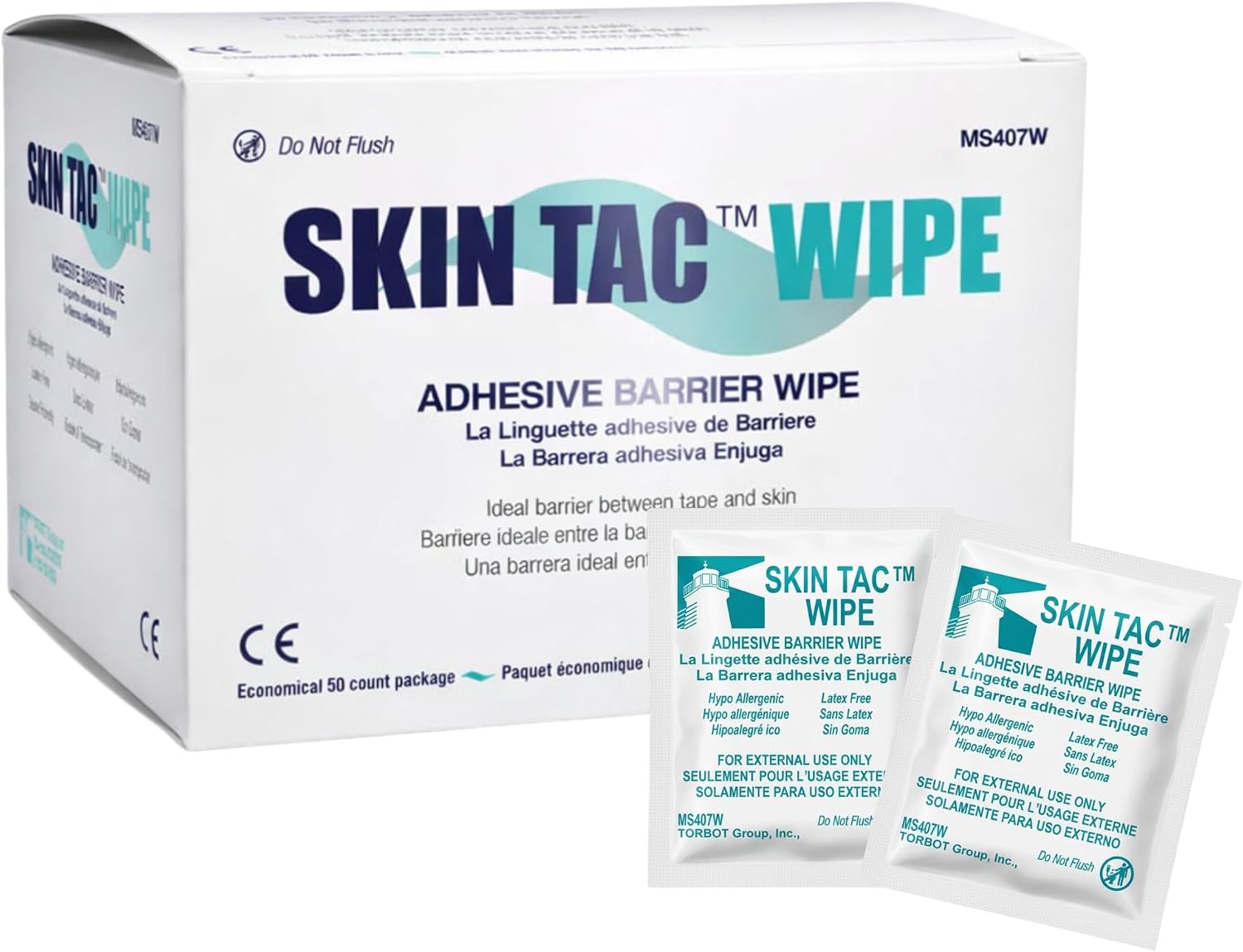
Skin Tac is a liquid adhesive barrier — a tackifying agent applied to the skin before sensor placement. It creates what reviewers consistently describe as a “bulletproof sticky barrier” that persists through sweat and showers. Multiple users in long-run reviews note that Skin Tac was a direct physician recommendation after repeated CGM failures, which is a meaningful signal: this isn’t just a community workaround, it’s a clinically recognized intervention.
How it works: Skin Tac contains a skin-safe adhesive compound that dries clear and bonds to both the skin and the back of the sensor’s adhesive patch. Once cured — typically one to two minutes after application — it significantly increases the sensor’s resistance to moisture and mechanical stress.
Application protocol:
- Complete your prep wipe and allow full air-dry.
- Apply Skin Tac with the included wipe in the area where the sensor’s adhesive patch will land — not the center where the needle enters.
- Allow Skin Tac to become tacky (30–90 seconds). It should feel sticky to the touch but not wet.
- Apply the sensor normally.
The most common application mistake is centering the Skin Tac wipe directly on the cannula insertion site. Leave the center clear. You’re reinforcing the adhesive perimeter, not the wound site.
Skin Tac vs. alternatives: Mastisol is the other widely cited liquid adhesive in this category. Mastisol is stronger — often used in surgical and wound care settings — but also significantly harder to remove and more likely to cause irritation with repeated use on the same skin patch. For routine CGM use, reviewers and clinicians generally favor Skin Tac’s balance of hold strength and skin tolerance. Healthline’s overview of CGM adhesive strategies notes Skin Tac as one of the most commonly recommended liquid barrier options in the diabetes community.
Layer Three: Overpatches — Not All Flex Is Equal
An overpatch is a thin, breathable, waterproof patch that adheres over the top of an already-placed sensor. It doesn’t cover the sensor’s transmitter dome — it frames or wraps around it, holding the edges of the factory adhesive down from the outside.
The Hierarchy of Overpatch Complaints
Across aggregated reviews, the failure patterns are consistent enough to treat as a decision framework:
Edge lifting and unraveling is the single most common complaint, mentioned across multiple brands. Skin Grip is frequently cited in community comparisons as the baseline reference — other brands are often evaluated by whether they perform better or worse than Skin Grip’s edge hold.
Adhesive residue on removal is the second most frequent complaint, particularly for patches with strong perimeter adhesive. Users with sensitive or crepey skin note that aggressive adhesive removal can cause skin trauma that outlasts the sensor wear window itself.
Application difficulty — patches folding onto themselves before placement — is specifically noted for Onida-style patches and any brand that uses a single-layer liner rather than a tabbed or split-release backing. The patch-folds-on-itself problem is most acute for solo appliers placing sensors on the back of the arm.
Stretch and flex failure is the dominant complaint for arm-mounted sensors. OmniPod accessory users note this explicitly: patches that don’t flex with arm movement peel faster than the sensor itself would have. A rigid patch on a moving limb concentrates stress at the non-stretching edge — which is exactly the failure point you were trying to solve.
By the Numbers
| Condition | Prep Wipe Alone | + Skin Tac | + Overpatch (full system) |
|---|---|---|---|
| Normal daily activity | Adequate for most | Strong | Overkill for many users |
| Heavy sweat / gym use | Often insufficient | Good | Recommended |
| Swimming / aquatic activity | Fails | Better | Required |
| High heat / humidity | Fails | Marginal | Required |
| Sensitive / crepey skin | Adequate | Use cautiously | Tape frame only |
Choosing an Overpatch for Your Sensor Site
Abdomen: Less mechanical movement than the arm. A standard non-stretch patch works. Prioritize edge adhesion and easy removal over flex.
Back of arm (Libre 3, Dexcom G7, Stelo): Maximum movement. Stretch is non-negotiable. Rigid patches will create a new edge-lift failure faster than no patch at all. Look for patches with fabric backing rather than film backing — fabric stretches more naturally with skin movement.
For users with sensitive or crepey skin: Silicone-edge or gentle-adhesive patches reduce trauma risk on removal. The tradeoff is lower initial hold. A shorter wear-window patch changed every five to seven days may be safer than pushing a single aggressive patch through a fourteen-day sensor life.
Frequently Asked Questions
Do I need both a prep wipe and an overpatch, or will one alone fix adhesion problems?
It depends on your failure mode. If your sensor loses grip within two to three days and you haven’t been using a prep wipe, start there — it’s free with most CGM supplies and solves the oil-contamination failure mode completely. If you’re already wiping and still losing sensors at day seven or eight in active or humid conditions, an overpatch is the right next layer. For aquatic athletes or anyone in sustained high heat, all three layers — wipe, Skin Tac, and overpatch — are the appropriate full system.
Can Skin Tac cause skin irritation or allergic reactions?
Yes, though reactions are not common. Skin Tac contains adhesive compounds that some users react to with contact dermatitis — redness, itching, or small raised bumps at the application site. Per Healthline’s overview of CGM adhesive options, users with known adhesive sensitivities should patch-test any new liquid adhesive on a small forearm area for 24 hours before full application. If you’re reacting to Skin Tac, Mastisol is not a safer alternative — it’s typically more irritating. Medical-grade skin barrier films are a gentler option worth discussing with your care team.
How do I remove an overpatch without pulling off the sensor underneath?
The key is slow, lateral tension rather than vertical lift. Pull the patch edge parallel to the skin surface — almost peeling it backward on itself — rather than pulling it up and away. Applying a small amount of adhesive remover or medical-grade oil (baby oil or dedicated adhesive remover wipes) to the patch edge softens the bond before you start. Work the edges before the center, and if the patch is fighting the sensor, stop and add more remover rather than increasing force. The American Diabetes Association’s Standards of Care notes skin trauma from repeated sensor placement and removal as a real cumulative concern, particularly for pediatric patients and older adults.
Do overpatches work the same way on arms vs. abdomens vs. other sensor locations?
No — and this is the most practically important thing to understand before buying. Arms move constantly and require stretch. Abdomens move less and tolerate rigid patches. The back of the upper arm is the hardest placement for solo application, which is also where the fold-on-itself application problem is most acute. If you’re placing a sensor on your arm solo, look specifically for patches with split-release or tabbed backing that let you position the patch before committing the adhesive.
Does the order of application — wipe first vs. sensor first — actually make a difference?
Yes, meaningfully. Wipe first, always. If you apply the sensor first and then try to wipe around it, you’re cleaning areas that don’t need cleaning while leaving the critical interface — the zone under the adhesive patch — contaminated. Skin Tac also must go down before the sensor; it creates a bond between skin and sensor adhesive. Applying it over an already-placed sensor does nothing useful.
Which overpatch brand works best for people with sensitive or crepey skin?
Based on patterns across aggregated user reviews and community comparisons, the consistent recommendation for sensitive skin is a patch with a silicone or low-trauma adhesive perimeter rather than a standard acrylic adhesive. Skin Grip’s gentler formulation variants and patches specifically marketed for sensitive skin typically generate fewer irritation reports. The tradeoff is real: gentle adhesives hold less aggressively, so users with sensitive skin often get better results from a shorter change interval — swapping the patch at day seven rather than running it the full fourteen days — than from chasing maximum hold strength with an aggressive patch.
The Decision Rule
If your sensors are failing before day seven and you haven’t tried a prep wipe: start with the wipe. It’s the cheapest intervention and solves the most common failure mode.
If you’re already wiping and losing sensors in sweat, heat, or water: add Skin Tac as your second layer. This is where physician recommendation data clusters — it’s the highest-leverage single upgrade for active users.
If you’re running the full Skin Tac system and still losing sensors, or if you’re in a sustained high-heat or aquatic environment: add an overpatch with stretch. Choose based on your sensor site. Arms need flex. Abdomens tolerate rigid patches. Sensitive skin needs a gentle-adhesive or silicone-perimeter patch at a shorter change interval.
All three layers together — wipe, Skin Tac, stretch overpatch — is the appropriate system for anyone whose sensor failure is costing them real money and real glycemic data. The math is simple: a single lost sensor at replacement cost pays for months of adhesive supplies.