A glucose meter — also called a blood glucose monitor or BGM — is the small handheld device that people with diabetes use to measure how much sugar (glucose) is in their blood at any given moment. You prick your fingertip with a tiny lancet, touch a test strip to the drop of blood, and the meter displays a number in seconds. That number guides meal decisions, insulin doses, and medication timing every single day. Getting it roughly right is not optional. So when budget meters from brands you’ve never heard of show up online for $10–$20 — full kit included — it’s worth asking a serious question: are they accurate enough to actually use, or are they a false economy that could quietly steer someone’s care in the wrong direction?
This article digs into that question using published accuracy standards, FDA clearance criteria, and patterns drawn from thousands of aggregated owner reviews. By the end, you’ll have a clear decision framework: when a budget meter is genuinely fine, when it’s a liability, and how to read the warning signs either way.
| EDITOR'S PICKMetene TD-4116 Blood Glucose Mo… | Mid-tierAUVON Blood Glucose Monitor Kit… | Budget pickMedline EvenCare G2 Blood Gluco… | |
|---|---|---|---|
| Test strips | 100 | 100 | — |
| Lancets | 100 | 100 | — |
| No coding | ✓ | ✓ | — |
| Results time | — | — | 6 sec |
| Carrying case | — | — | ✓ |
| Logbook | — | — | ✓ |
| Price | $34.99 | $25.99 | $21.59 |
| See on Amazon → | See on Amazon → | See on Amazon → |
The Accuracy Standard Every Meter Is Supposed to Meet
Before comparing any two meters, you need to know what “accurate” legally means for a home blood glucose monitor sold in the United States.
The FDA requires that blood glucose monitoring systems meet ISO 15197:2013 performance criteria to receive 510(k) clearance for consumer use. Per ISO 15197:2013 — the International Organization for Standardization’s standard for in vitro diagnostic blood-glucose monitoring systems — at least 95% of results must fall within ±15 mg/dL of a laboratory reference value when blood glucose is below 100 mg/dL, and within ±15% when it is at or above 100 mg/dL. A second threshold requires 99% of results to land within ±20% of the lab reference value.
In plain terms: if your true blood sugar is 100 mg/dL, a cleared meter can legally return anything between 85 and 115 and still pass the standard. At 200 mg/dL, the legal window stretches to 170–230.
That is a wide band. And it applies to both budget and name-brand meters alike. The Contour Next ONE is one of the most consistently accurate consumer meters available and routinely beats the ISO threshold in independent evaluations — Healthline, in its coverage of home blood glucose meter accuracy, notes it frequently performs within ±5% of lab values. A $12 no-name kit is not held to a stricter bar by the FDA just because it costs less. It must clear the same minimum gate — and many do. The practical difference shows up not in whether a meter is cleared but in how consistently it performs across the full distribution of its readings, and how well it handles the low-glucose range where precision matters most.
Budget, Mid-Tier, and Premium Meters Compared
The market breaks into three meaningful tiers. Understanding what each tier actually delivers — beyond the price tag — is the core of any useful buying decision.
Budget Tier: AUVON, Metene TD-4116, Glucoracy, MicroTech, EvenCare G2
Budget meters typically run $10–$25 for the full kit — meter, lancets, lancing device, and an initial supply of strips — with replacement strips priced at roughly $0.15–$0.20 per strip. At 200 tests per month, a common frequency for people managing Type 2 diabetes on oral medications, that works out to approximately $30–$40 per month in ongoing strip costs, or $360–$480 per year.
Aggregated owner reviews reveal consistent patterns across the budget category. AUVON meters carry strong aggregate ratings, but the most instructive owner feedback includes a recurring qualifier: results are best treated as ballpark ranges rather than precise numbers. For someone using a meter purely to spot trends or confirm they are not in danger territory, ballpark may be acceptable. For someone titrating insulin on a sliding scale, ballpark is not acceptable.
Glucoracy generated a candid complaint embedded inside a five-star review: the owner described four consecutive tests returning widely divergent results, including one reading of 41 mg/dL that the owner suspected was erroneous. A 41 mg/dL reading, if acted upon, would normally trigger a hypoglycemia response — juice, glucose tablets, possibly a call to a provider. If the real number was 90 mg/dL, that response is unnecessary and potentially disorienting. This is the specific failure mode that matters clinically: not that the meter is wrong on average, but that it can be dramatically wrong on a single reading.
Metene TD-4116 reviews consistently highlight strip cost above all else. Owners cite per-strip pricing as the deciding factor, and the math supports them at high test volumes. Accuracy reviews are generally positive but follow the same “good enough for the price” pattern common across the budget tier.
MicroTech and EvenCare G2 owners emphasize large displays and fast setup. Both traits make these options particularly well-suited to the caregiver-purchase use case — an aging parent who needs a simple, low-friction tool — rather than a tech-forward Type 1 user optimizing tightly around CGM data.
iHealth reviews surface a recurring theme: owners initially attribute poor readings to the device, then discover the problem was technique — insufficient blood sample, applying blood before the meter was ready, or testing with cold hands. This is a genuine confound. A budget meter with a steeper learning curve may perform worse in practice than its specifications imply, because it is less forgiving of imperfect technique than a more polished mid-range device.
Bottom line for the budget tier: Cleared budget meters used with careful technique are a defensible, cost-conscious choice for Type 2 users monitoring trends on oral medications only. They are a meaningful liability for insulin-dependent users where single-reading accuracy affects dosing math.
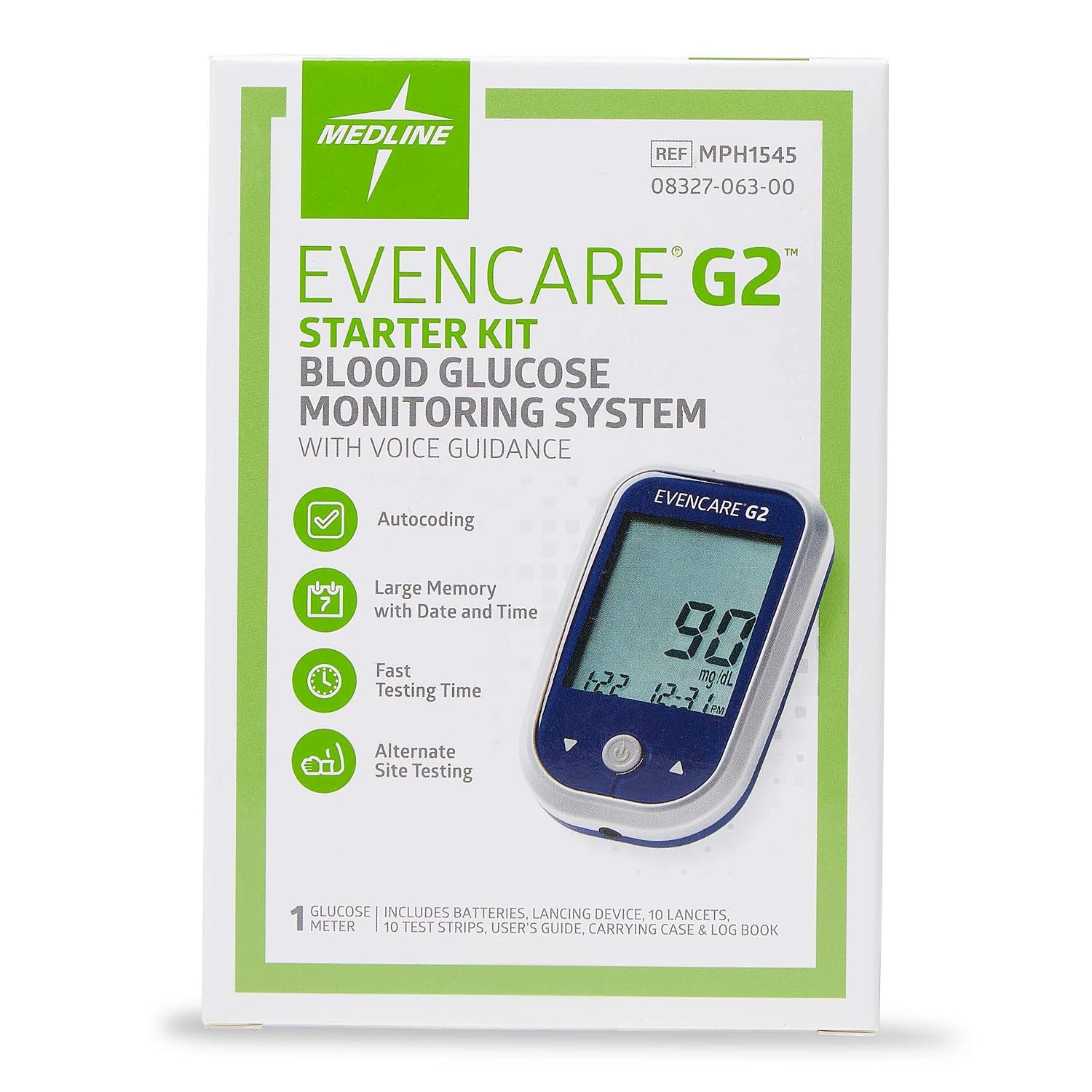
Medline
$21.59
In stock on Amazon
Check price on AmazonMid-Tier: Contour Next ONE, Accu-Chek Guide, OneTouch Verio Flex
Mid-range meters typically retail for $20–$40 for the device, with strips priced at roughly $0.55–$0.75 per strip out of pocket. At 200 tests per month, that is $110–$150 per month without insurance — or as low as $10–$40 per month with insurance or discount programs applied to name-brand strips. Annually, the out-of-pocket difference between budget and mid-range strip pricing can exceed $1,000 for uninsured high-frequency testers, which is why the budget tier exists as a real access solution rather than simply a compromise.
The Contour Next ONE consistently outperforms the ISO 15197:2013 minimum in third-party evaluations. Healthline, in its published review of home blood glucose meter accuracy, notes the device regularly achieves results within ±5% of laboratory reference values. The Accu-Chek Guide is similarly well-regarded and offers a spill-resistant strip vial that reduces handling errors. The OneTouch Verio Flex provides Bluetooth connectivity and a color-coded range display that helps newer patients interpret context around their numbers, not just the number itself.
For insulin-dependent patients, the accuracy headroom in this tier is the primary argument for absorbing the higher strip cost or investing time in an insurance prior-authorization process. The American Diabetes Association, in its Standards of Medical Care in Diabetes — published annually in the journal Diabetes Care and available through diabetesjournals.org — recommends that patients use FDA-cleared meters and understand device accuracy limitations when making clinical decisions. Mid-range meters make that recommendation easier to satisfy.
Bottom line for the mid-tier: The default recommendation for most people with diabetes who test regularly. The strip cost premium is justified for insulin users; for everyone else, it buys meaningful accuracy headroom over budget options.
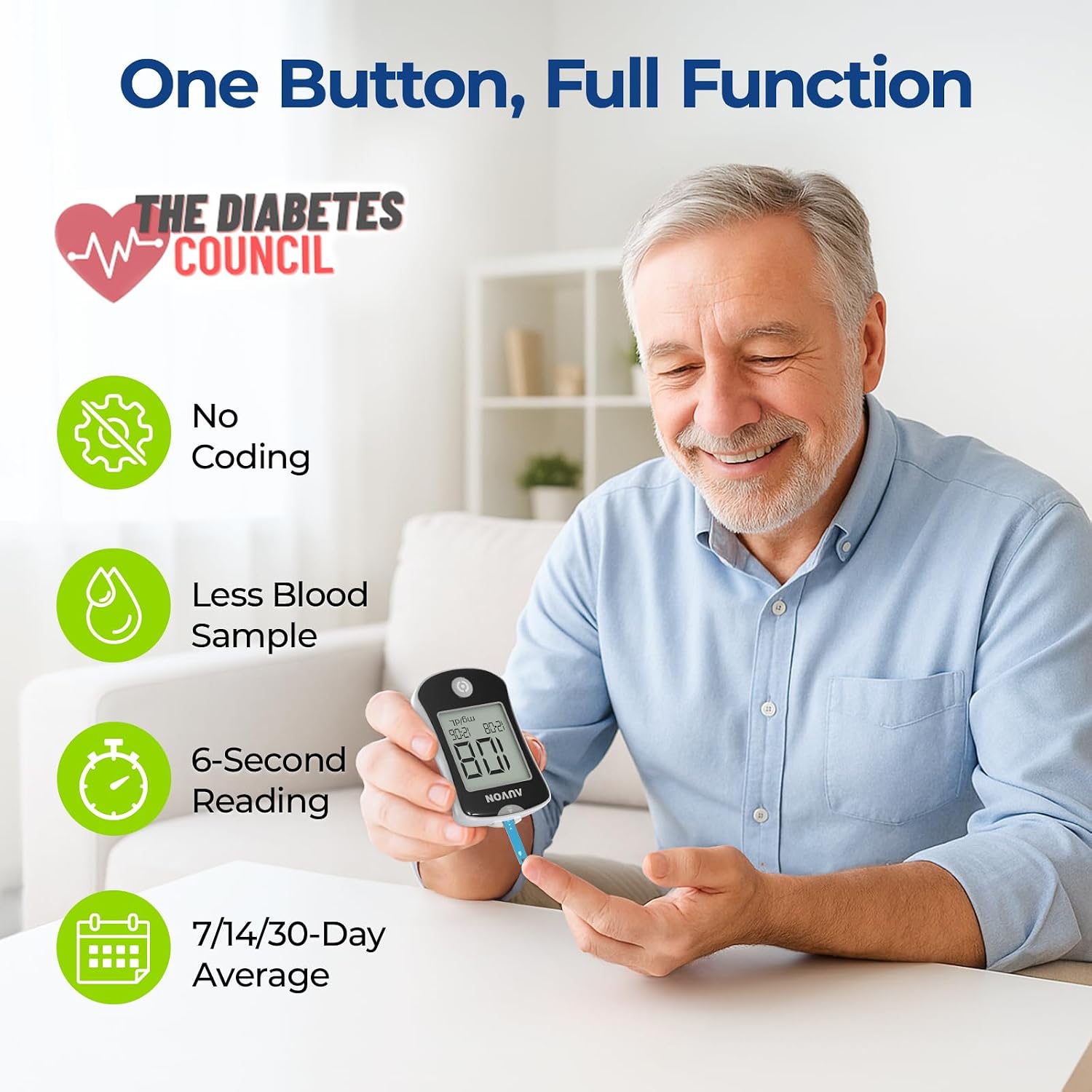
AUVON
$25.99
In stock on Amazon
Check price on AmazonPremium and CGM-Paired Tier: Dexcom G7, FreeStyle Libre 3
Continuous glucose monitors are not fingerstick meters, but they belong in this comparison because they represent the ceiling of what personal glucose monitoring can deliver and are the most common upgrade path from mid-range BGMs. CGMs use a small sensor worn on the body — typically the upper arm or abdomen — to measure interstitial glucose every one to fifteen minutes depending on the system, and transmit readings to a smartphone or dedicated receiver.
FreeStyle Libre 3 requires no fingerstick calibration and provides a continuous glucose trend line rather than isolated data points — a qualitative shift in the information available to the user, not just a quantitative one. Healthline’s CGM comparison coverage describes this trend-line view as particularly useful for identifying patterns around meals and exercise that spot-checks can miss entirely. Dexcom G7 offers real-time alerts for high and low glucose events, which is especially relevant for insulin-dependent patients who need warning before a hypoglycemic event rather than confirmation of one after the fact.
The cost structure differs fundamentally from strip-based meters. Sensors run $70–$150 per 10–14 days depending on the system and insurance coverage, with many patients paying $0–$30 monthly with adequate insurance. Without insurance, CGMs are expensive. With insurance — particularly for Type 1 or insulin-using Type 2 patients — they are increasingly covered and represent a meaningful improvement over fingerstick monitoring. Fingerstick BGMs remain necessary as backup and for calibration confirmation on some CGM systems.
Bottom line for the premium tier: The right choice for insulin-dependent patients whose insurance covers it, or for any patient whose provider recommends continuous trend data over intermittent spot checks.
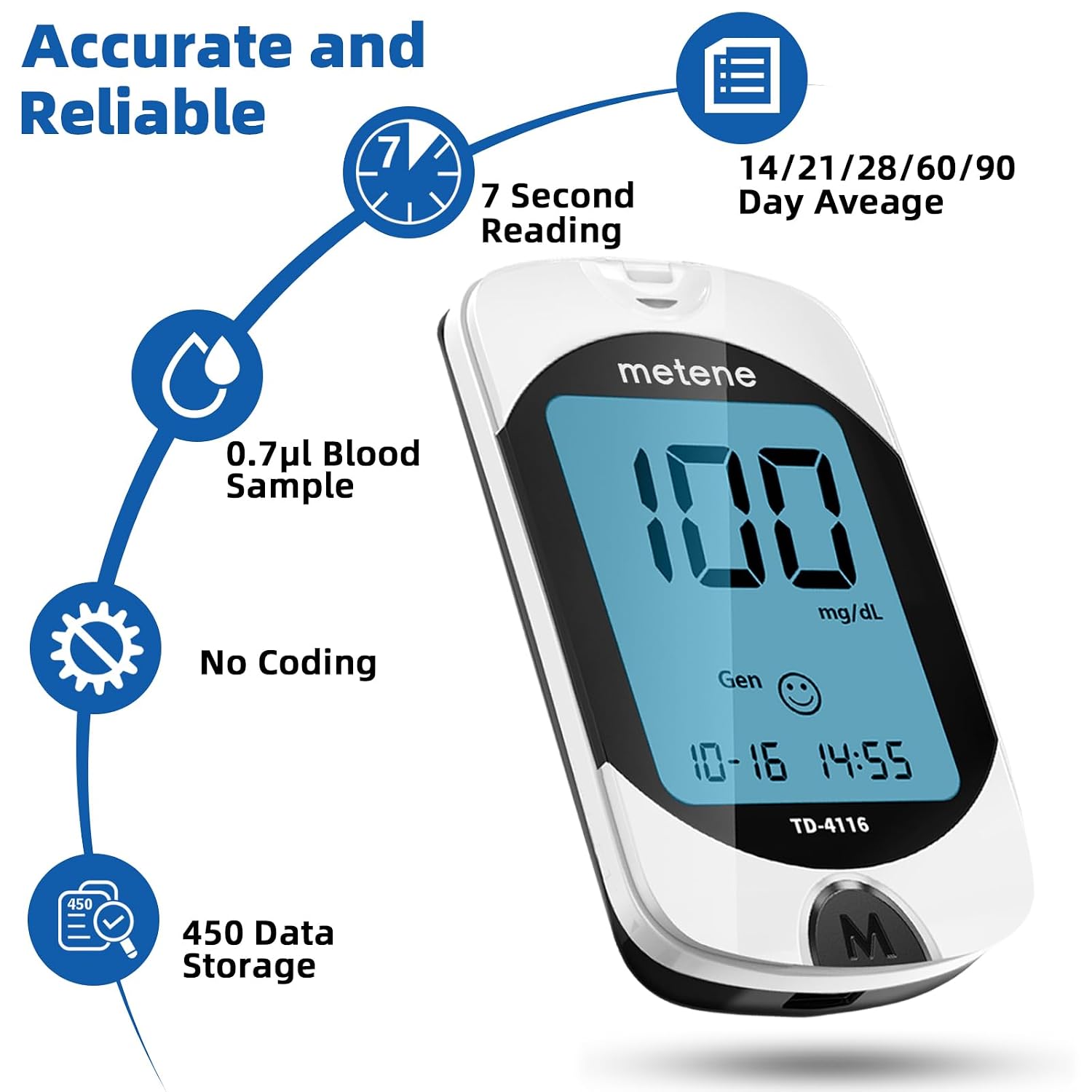
Metene
$34.99
In stock on Amazon
Check price on AmazonFDA Clearance: The Question to Ask Before Anything Else
Are AUVON, Metene, Glucoracy, and similar budget meters FDA-cleared?
The answer varies by specific product and SKU. The FDA maintains a publicly searchable database — the 510(k) Premarket Notification database, accessible through fda.gov — where any device can be looked up by manufacturer name or product code. Some budget meters have received 510(k) clearance. Others are sold in a gray area: marketed for “general wellness” or with language that implies glucose monitoring without explicit FDA clearance for diagnostic use.
The FDA’s guidance document titled “Blood Glucose Monitoring Test Systems for Prescription Point-of-Care Use,” available through the guidance document search function at fda.gov, describes the regulatory framework governing these devices. The American Diabetes Association’s Standards of Medical Care in Diabetes — 2024 edition, published in the journal Diabetes Care through diabetesjournals.org — recommends that patients verify FDA clearance before relying on any meter for clinical decisions, regardless of price tier.
Practical step: Search the FDA’s 510(k) database by manufacturer name before purchasing any budget meter. If you cannot find a clearance record, treat that as a meaningful gap in the product’s documentation — not merely a paperwork inconvenience.
FSA/HSA note: Most FDA-cleared glucose meters and their strips qualify as FSA/HSA-eligible expenses. Clearance documentation is often required by FSA administrators for reimbursement. Not every budget kit on the market discloses clearance status in a way that satisfies that review process. Confirm before purchasing with FSA/HSA funds.
Technique as a Hidden Accuracy Variable
A meter can only perform as well as the technique used to operate it. The pattern of owners blaming the device before discovering a technique error — described above in the iHealth review data — surfaces across budget-tier reviews consistently and is worth treating as a category-wide caution.
Common errors that inflate apparent inaccuracy include:
- Insufficient blood volume. Most modern meters require 0.5–1.5 µL of blood. Squeezing the finger hard to force a larger drop dilutes the sample with interstitial fluid and skews results low.
- Timing errors. Applying blood before the meter signals readiness, or removing the strip too early, is more common with unfamiliar devices that lack clear audio or visual prompts.
- Temperature effects. Mayo Clinic’s patient guidance on blood sugar testing — published under the title “Blood sugar testing: Why, when and how” and available at mayoclinic.org — notes that glucose meters can return unreliable results when used in cold environments or when the patient’s hands are cold. Warming hands for 30 seconds before testing is a practical mitigation.
- Expired or improperly stored strips. Heat and humidity degrade the enzyme layer on test strips. A strip stored in a car glove compartment through a summer month may read falsely low even if the meter itself is functioning correctly.
Budget meters tend to have less intuitive interfaces and thinner instruction manuals than mid-range devices. That is a design tradeoff, not a defect — but it does mean that review-reported accuracy problems are sometimes technique problems in disguise.
Frequently Asked Questions
If I test twice in a row and get different numbers, is my meter broken?
Not necessarily. Even high-performing consumer meters show small variations between consecutive readings because each test uses a slightly different blood drop drawn at a slightly different capillary moment. Per ISO 15197:2013 performance criteria — the International Organization for Standardization’s standard for blood-glucose monitoring systems — a variance of 10–15% between readings can fall within normal device performance. If consecutive readings diverge by more than 20–30 mg/dL on a single fingerstick with no change in conditions, check strip expiration, sample size adequacy, and whether the meter is due for a control solution test.
How close does a home meter need to be to a lab result to be safe?
The FDA’s minimum threshold, as described in its blood glucose monitoring guidance documentation available through fda.gov, requires that 95% of readings fall within ±15 mg/dL (below 100 mg/dL) or ±15% (at or above 100 mg/dL) of a laboratory reference value. Many endocrinologists use ±20% as a practical working rule for home meters. For patients on insulin, a meter that consistently reads at the edge of the ±15% window can meaningfully distort dosing calculations.
Are unbranded meters FDA-cleared?
Some variants are; others are not. Clearance is product-specific, not brand-wide. Verify each specific model in the FDA’s 510(k) database — searchable by manufacturer name through fda.gov — before relying on the device for diabetes management decisions.
Does the lancing device included in a budget kit matter?
Included lancing devices in budget kits are often functional but basic — fixed depth, fewer comfort settings, and wider-gauge lancets. For patients who test frequently, have sensitive fingertips, or have circulation issues, a separate lancing device with adjustable depth and a finer-gauge lancet in the 28G–33G range is worth the modest additional cost. Owners across multiple kit reviews report meaningfully better comfort with aftermarket lancing devices over budget-kit defaults.
At what point should I upgrade from a budget kit to a name-brand meter?
Use this decision rule: if you are on insulin — especially rapid-acting insulin where doses are calculated from fingerstick values — the accuracy headroom of a mid-tier meter like the Contour Next ONE or Accu-Chek Guide is worth the strip cost difference, or worth the effort of an insurance authorization. If you are managing Type 2 with oral medications only and testing primarily to observe trends and stay out of danger range, a cleared budget meter used with careful technique is a defensible, cost-conscious choice. If test volume is high enough that strip cost is a genuine financial burden and insurance does not adequately cover mid-range strips, the budget option addresses a real access problem — not merely a preference.
The Decision Frame
- Insulin-dependent, CGM gap coverage: A mid-tier meter such as the Contour Next ONE or Accu-Chek Guide minimizes dosing error risk; per-reading accuracy at low glucose values outweighs strip cost considerations. AUVON — $25.99
- Type 2, oral medications only, trend monitoring, cost-sensitive: A cleared budget meter — verify 510(k) status through fda.gov before purchase — used with careful technique and control solution testing is a reasonable, informed choice. Medline — $21.59
- Caregiver purchase for an elderly patient where setup simplicity is the priority: MicroTech or EvenCare G2’s large displays and straightforward setup reduce technique-related errors; verify FDA clearance before purchase. Medline — $21.59
- Insulin-dependent with good insurance coverage: A CGM such as FreeStyle Libre 3 or Dexcom G7 paired with a mid-tier BGM for backup; continuous trend data eliminates most single-reading risk. Metene — $34.99
- Uninsured, high test volume, budget-first constraint: A cleared budget meter combined with strict technique discipline and weekly control solution testing. Understand what “ballpark range” means for your specific care plan before committing to this path. Medline — $21.59
The cheap kits are not fraudulent by definition. Some are genuinely cleared, genuinely functional, and genuinely the right call for specific situations. But “right for someone” is not the same as “right for you.” Know the ISO standard, check the FDA clearance status, account for your own technique reliability, and match the meter to what the numbers are actually being used to decide.