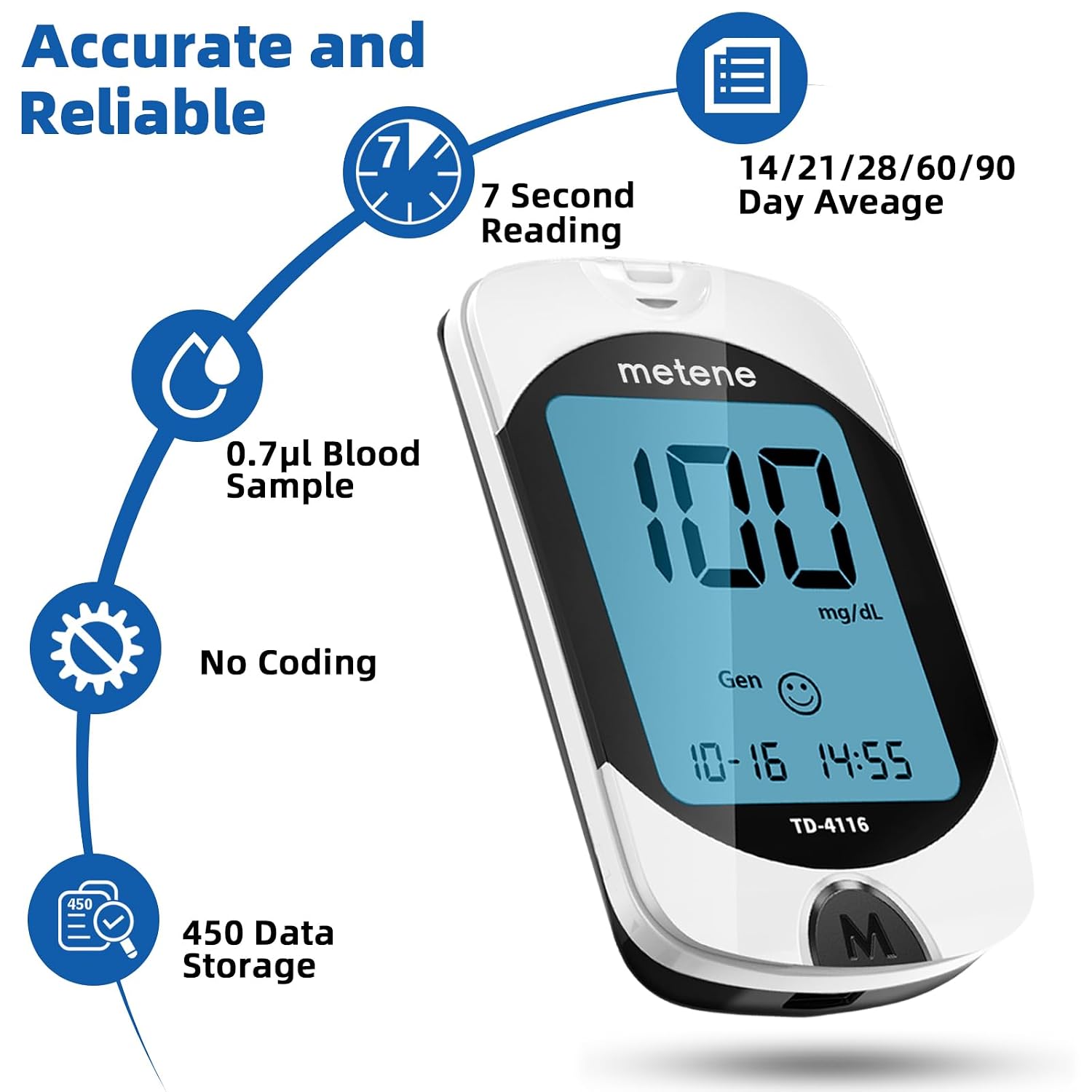
If you were just handed a diabetes diagnosis, the list of things to buy can feel overwhelming fast. Near the top of that list is a glucose meter — a small, handheld device that measures the amount of sugar (glucose) in a drop of your blood drawn from a fingertip. You use it with test strips (single-use tabs that chemically react with your blood) and a lancet (a tiny spring-loaded needle that pricks your finger). Together, these three things form the core of daily diabetes self-management. The good news: you don’t need to spend a lot to get started. Several complete, FDA-cleared kits land comfortably under $35 — and this guide will walk you through exactly what separates the smart buys from the ones that cost you more later.
| EDITOR'S PICKCareSens N Blood Glucose Monito… | Mid-tierAUVON Blood Glucose Monitor Kit… | Budget pickAUVON Blood Glucose Monitor Kit | |
|---|---|---|---|
| Test strips | 100 | 100 | 50 |
| Lancets | 100 | 100 | 50 |
| Lancet size | — | 30G | 30G |
| Control solution | ✓ | — | — |
| Coding | — | No coding | No coding |
| Travel case | ✓ | — | — |
| Price | $31.99 | $25.99 | $19.98 |
| See on Amazon → | See on Amazon → | See on Amazon → |
Why the Upfront Price Is the Wrong Number to Optimize
Here’s the tradeoff that trips up almost every new buyer: the meter itself is nearly free. The money is in the strips.
This is the razor-and-blade model, and the diabetes supply industry runs on it. A meter that retails for $9 might lock you into strips that cost $0.50–$0.75 each. A meter that costs $25 might use strips at $0.18 each. If you’re testing four times a day — a common starting target per the American Diabetes Association’s Standards of Care in Diabetes 2025 — that difference adds up fast.
By the numbers: Monthly strip cost at 4 tests/day (120 strips)
| Strip price per unit | Monthly cost | Annual cost |
|---|---|---|
| $0.18 | ~$21.60 | ~$259 |
| $0.35 | ~$42.00 | ~$504 |
| $0.65 | ~$78.00 | ~$936 |
That’s a $677/year swing — from the same testing frequency — just based on which meter you picked. This is the number that matters, not the $9 vs. $25 sticker at checkout.
So when we evaluate kits under $35, we’re really evaluating the total cost of ownership over the first year, with the starter kit price as a tie-breaker, not the headline.
What to Look for in a Budget All-In-One Kit
Before getting into specific products, here’s the decision framework. A solid under-$35 kit should clear all five bars:
1. FDA clearance for OTC use. The FDA’s guidance on Self-Monitoring Blood Glucose Test Systems for Over-the-Counter Use sets accuracy standards (within ±15% of lab values 95% of the time). Any product sold legally in U.S. retail has cleared this bar, but it’s worth knowing — it’s why you should avoid gray-market meters sold outside normal retail channels.
2. Affordable strip ecosystem. Target $0.20–$0.35 per strip at standard retail, or confirm your insurance formulary covers the brand. This single variable determines whether the kit is actually affordable long-term.
3. Kit completeness. A true all-in-one kit includes the meter, a starter supply of strips (typically 10–25), lancets, a lancing device, and a carrying case. Some budget kits quietly omit the case or include only 10 strips — barely enough for a week.
4. Accuracy track record. Consumer Reports’ Blood Glucose Monitors Buying Guide consistently rates a handful of budget models at accuracy levels competitive with premium devices. Accuracy doesn’t require a premium price.
5. FSA/HSA eligibility. Glucose meters, strips, and lancets are FSA/HSA-eligible medical expenses under IRS Publication 502. If you have one of these accounts, every dollar spent here is pre-tax. Flag this at checkout — not every retailer automatically codes it correctly.
The Top Budget Kits Worth Considering
ReliOn Premier Classic Meter Kit
Retail range: ~$9–$14 for the meter; strips ~$18 for 50-count
The ReliOn line — Walmart’s house brand, manufactured in partnership with Arkray — has become the default recommendation in online diabetes communities for cash-pay buyers. Healthline’s overview of budget glucometers consistently lists the ReliOn Premier as one of the most accessible starting points for cost-conscious patients.
The starter kit typically includes the meter, 10 test strips, 10 lancets, a lancing device, and a carrying case. That gets you through roughly two to three days of testing before you need to purchase a full strip supply.
The real math: ReliOn Premier strips retail at Walmart for approximately $18 per 50-count box, or about $0.36 per strip. At four tests per day, that’s roughly $43/month — toward the middle of the range. However, Walmart also sells a 100-count strip box for approximately $36, dropping the per-strip cost to $0.36 and making bulk buying straightforward.
Tradeoff to name explicitly: ReliOn strips are sold almost exclusively at Walmart. If you don’t live near a Walmart or shop there regularly, the convenience equation changes. Shipping availability and third-party seller pricing can vary, and strip freshness (expiration date) matters — a known concern with any online strip purchase.
If X, then Y: If you live within easy distance of a Walmart and are cash-paying without insurance coverage, the ReliOn Premier kit is the strongest cost-per-strip argument in this price tier.
Contour Next EZ Meter Kit
Retail range: ~$14–$25 for the kit; strips ~$25–$30 for 50-count
The Contour Next platform from Ascensia Diabetes Care occupies a different position: it’s one of the few budget-adjacent meters with published third-party accuracy data placing it above the FDA minimum threshold. Consumer Reports has rated Contour Next strips among the most accurate in their testing category.
The EZ variant is the stripped-down version of the Contour Next One (which adds Bluetooth app connectivity). The EZ kit typically bundles 20–25 strips, a lancing device, lancets, and a case.
The real math: Contour Next strips run approximately $0.45–$0.55 per strip at standard retail. At four tests per day, that’s roughly $54–$66/month — meaningfully higher than ReliOn. However, Contour Next strips are widely covered on commercial insurance formularies and are on the Medicare Part B approved strip list, which changes the calculus entirely if you have coverage.
FSA/HSA flag: Fully eligible. If you’re purchasing with FSA/HSA funds, the strip cost difference narrows against gross income, especially in higher tax brackets.
Tradeoff to name explicitly: You’re paying a per-strip premium for wider retail availability, better insurance coverage odds, and documented accuracy data. That’s a rational tradeoff for buyers who will eventually use insurance or who prioritize accuracy verification from published sources.
If X, then Y: If there’s any possibility you’ll be using commercial insurance or Medicare within the next 6–12 months, starting on a Contour Next platform avoids a meter switch later. The accuracy reputation also makes it a reasonable choice for anyone who wants a secondary meter to cross-check a CGM (continuous glucose monitor) reading.
CVS Health Advanced Glucose Meter Kit
Retail range: ~$14–$20; strips ~$20–$25 for 50-count
CVS’s store-brand meter (manufactured by a third-party OEM, frequently Prodigy or similar) follows the same logic as ReliOn: deep distribution within a single retail chain, competitive strip pricing, and a complete starter kit. Across aggregated pharmacy reviews, owners report the CVS Advanced kit as reliable for basic daily monitoring.
The real math: CVS store-brand strips typically run $0.35–$0.45 per strip, putting monthly costs at $42–$54 at four tests daily. CVS ExtraCare and CarePass discounts can reduce this meaningfully for regular shoppers.
Tradeoff to name explicitly: Like ReliOn at Walmart, CVS strips are a chain-exclusive product. Traveling, moving, or losing access to a CVS location creates a supply continuity risk. Strip expiration is also a factor when buying online.
If X, then Y: If CVS is your primary pharmacy and you’re enrolled in CarePass or a similar loyalty program, the effective strip cost with discounts can rival ReliOn pricing. This is the logical default for CVS-anchored buyers.
The Upgrade Conversation: When $35 Isn’t the Right Ceiling
This guide is focused on under-$35 kits, but a practitioner-level buyer should know exactly where this tier ends and when to push clients or family members up to the next level.
The under-$35 segment makes sense for:
- Newly diagnosed Type 2 patients starting lifestyle management before any CGM conversation
- Backup meters for CGM users (CGM sensors can fail; a fingerstick meter is always the backup)
- Caregivers building a travel kit for a family member
- Pre-diagnosis / prediabetes monitoring where test frequency is lower (1–2 times per day)
The case for moving up begins when:
- Testing frequency exceeds 6–8 times per day (common in Type 1 management), where strip cost compounds sharply and a CGM conversation becomes economically rational
- The patient’s commercial insurance covers a mid-tier meter (Accu-Chek Guide, OneTouch Verio) at low or no copay — at that point, strip cost is moot and accuracy/feature set matters more
- Bluetooth connectivity is needed for caregiver remote monitoring or logging integration
Per the Mayo Clinic’s guidance on blood sugar testing frequency, individual testing targets should be set with a healthcare provider — frequency isn’t one-size-fits-all, and that variable drives the cost math more than anything else.
Decision Rules: If X, Then Y
If you’re cash-paying and price-sensitive above all else: ReliOn Premier kit at Walmart. Lowest strip cost in wide retail distribution. Accept the Walmart dependency.
If there’s any chance of insurance coverage in the next year: Contour Next EZ. Formulary coverage is broad, accuracy data is published, and switching meters mid-stream wastes the starter strip supply.
If CVS is your everyday pharmacy: CVS Advanced kit with CarePass discounts. The effective cost math is competitive and the convenience factor matters for long-term adherence.
If this is a backup meter for a CGM user: Any of the above will work; prioritize strip shelf life and go with whatever matches the store you’ll restock at most easily.
If FSA/HSA funds are available: Use them — all three kits and their ongoing strip purchases are eligible. Run the pre-tax math; at a 22% federal bracket, a $500/year strip habit costs you effectively $390.
If testing frequency will exceed 6 times daily: Skip this tier entirely. At that volume, the economics of a CGM system (Dexcom G7, FreeStyle Libre 3) often outperform the cumulative strip cost within six months. That’s a different guide — but it’s the honest redirect.
Getting the meter right is step one. Getting the strip economics right is the step most newly diagnosed patients miss. Run the math before you buy, flag FSA/HSA eligibility at checkout, and keep the insurance formulary question in your back pocket — because the meter that’s free with insurance is often better than the meter that’s cheapest at retail.