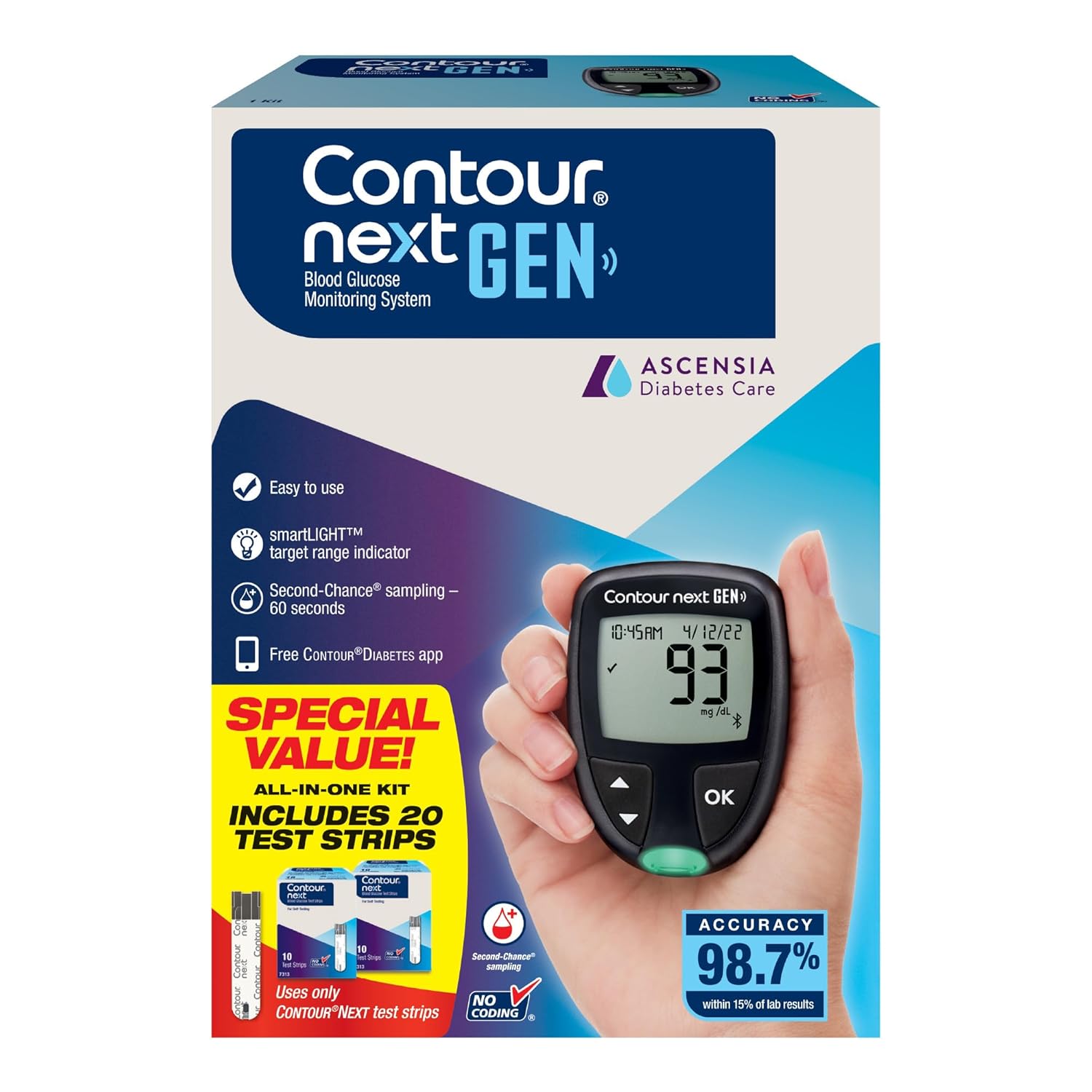
If you’ve just been told you need to monitor your blood sugar at home, the pharmacy shelf can feel overwhelming. There are dozens of devices — called blood glucose meters (BGMs), handheld tools that measure the sugar level in a small drop of your blood — and they range from about $10 to $80. But here’s the thing most people only figure out after they’ve already bought one: the meter is practically a loss leader. The real expense is the test strips — the small disposable tabs you feed into the meter every single time you check. If you test twice a day, that’s 60 strips a month. Four times a day? 120 strips. The meter cost is a one-time hit. The strip cost is a subscription you never signed up for. This article does the monthly math on the most common meters, names the tradeoffs, and gives you a clear decision rule so you can pick the right system before you commit.
| EDITOR'S PICKAccu-Chek FastClix Glucose Moni… | Mid-tierCareSens N Blood Glucose Monito… | Budget pickCareSens N Plus Bluetooth Blood… | |
|---|---|---|---|
| Lancets | 108 | 100 | 100 |
| Control solution | ✓ | ✓ | — |
| Travel case | — | ✓ | ✓ |
| Bluetooth | — | — | ✓ |
| Price | $90.00 | $31.99 | $23.99 |
| See on Amazon → | See on Amazon → | See on Amazon → |
Why the Meter Price Tag Is Almost Irrelevant
Walk into any pharmacy and the meter pricing looks almost random. A ReliOn Premier Classic sits at $9. A Contour Next One is around $30. An Accu-Chek Guide Me might be $20 after rebate. The hardware price spread is maybe $70 across the entire category. That sounds meaningful — until you realize a single box of brand-name strips often runs $40–$75 for 50 strips, and some proprietary systems are even pricier.
The math flips the decision entirely.
By the numbers — 30-day strip cost comparison (cash-pay, 2025–2026 retail pricing):
| System | Strip price (50 ct) | Cost/strip | 2x/day (60 strips) | 4x/day (120 strips) |
|---|---|---|---|---|
| ReliOn Premier (Walmart) | ~$9 | $0.18 | ~$11/mo | ~$22/mo |
| Contour Next (major retailers) | ~$30–$35 | $0.60–$0.70 | ~$36–$42/mo | ~$72–$84/mo |
| OneTouch Verio Reflect | ~$40–$50 | $0.80–$1.00 | ~$48–$60/mo | ~$96–$120/mo |
| Accu-Chek Guide | ~$35–$45 | $0.70–$0.90 | ~$42–$54/mo | ~$84–$108/mo |
Pricing reflects aggregated cash-pay retail averages as of early 2026. Insurance, mail-order pharmacy, and FSA pricing vary significantly.
Over 12 months at four checks per day, the difference between the cheapest and most expensive strip ecosystem in this table is roughly $1,000 — before you even touch the meter cost. That’s the number that should dominate your decision.
The Four Levers That Determine Real Monthly Cost
Understanding these levers lets you pressure-test any meter claim you’ll encounter from a manufacturer, a pharmacist, or a product listing.
1. Strip Price and Proprietary Lock-In
Every meter uses its own strips. They are not interchangeable. This is intentional — manufacturers often subsidize the hardware and recoup margin on consumables, a model the FDA’s guidance on blood glucose monitoring devices acknowledges as a structural feature of the category. Once you’re on a meter, switching strip ecosystems means buying a new meter too. That lock-in is worth factoring in at the point of purchase, not after.
The tradeoff: ReliOn strips at Walmart are genuinely the lowest cash-pay option in the U.S. market. Owners report few complaints about the strips themselves, and accuracy data submitted to the FDA for the Premier line meets the ISO 15197:2013 standard (within ±15% of lab value for 95% of readings). For someone without insurance coverage on strips, this system is difficult to argue against on cost alone.
The countervailing risk: If you travel, get sick, or need strips urgently, Walmart is your only reliable source. Other pharmacies don’t stock ReliOn strips. That’s a real operational constraint.
2. Insurance Coverage and Formulary Tier
The cash-pay math above inverts almost completely once insurance enters the picture. Many commercial plans cover test strips at a fixed copay — often $10–$35 per box — regardless of the retail price of the strips. The American Diabetes Association’s Standards of Care in Diabetes 2025 notes that strip coverage varies substantially by plan and that formulary tier placement is a key driver of out-of-pocket cost.
What this means practically: If your plan covers Contour Next at a $15 copay, the cash-pay math no longer applies. A $15 copay on a 100-count box is roughly $0.15/strip — competitive with ReliOn’s cash price. The decision shifts from “which strips are cheapest?” to “which strips does my plan prefer?”
Medicare Part B covers glucose meters and strips as durable medical equipment (DME) — but only for insulin-using beneficiaries under most circumstances, and only through a Medicare-assigned supplier. Coverage for non-insulin-using Type 2 patients has been narrowed over time. Healthline’s overview of blood glucose meters for 2025 flags this as one of the most misunderstood coverage gaps in the category.
Action step: Before buying any meter, call your insurer and ask: “What’s my formulary tier for test strips, and which brands are preferred?” Two minutes on the phone can save hundreds of dollars annually.
3. FSA/HSA Eligibility
Blood glucose meters and strips are FSA/HSA-eligible — both qualify as medical expenses under IRS Publication 502. This is worth flagging explicitly because it changes the effective cost for anyone with a funded health savings account or flexible spending account.
If you’re in a 22% federal tax bracket and spending $600/year on strips, running that purchase through an HSA saves you roughly $130 in taxes. It’s not glamorous math, but it’s real money. Meters themselves are eligible too. Look for the FSA-eligible badge when purchasing, or confirm eligibility with your account administrator before checkout.
4. Accuracy, and When It Actually Matters
Accuracy is the specification buyers cite most — and sometimes overweight. The FDA’s performance standard for BGMs requires that 95% of readings fall within ±15% of a lab reference value for glucose above 75 mg/dL, and within ±15 mg/dL for values below 75 mg/dL.
Consumer Reports’ blood sugar monitor buying guide notes that several mid-range meters — including Contour Next and Accu-Chek Guide — have published accuracy data tighter than the minimum standard, with some studies showing 95% of readings within ±10%. For most Type 2 patients monitoring trends, the difference between ±10% and ±15% accuracy has limited clinical impact. For a Type 1 patient dosing insulin on a BGM reading, tighter accuracy matters more.
The tradeoff to name explicitly: If you are dosing insulin directly off a BGM number, accuracy specification is worth paying a premium for. If you’re monitoring trends to understand how meals and activity affect your blood sugar, a budget strip that meets the minimum standard is likely sufficient. Mayo Clinic’s guidance on blood sugar testing frames this well: the goal of home monitoring is actionable pattern recognition, not lab-grade precision.
Decision Frame: Which System for Which Buyer
Here’s where we make this concrete. Based on published specs, aggregated owner reviews, and the cost structure laid out above, here’s the decision logic:
If you’re cash-pay with no insurance coverage on strips: The ReliOn Premier at Walmart is the rational choice. The math is straightforward. The accuracy meets FDA standards. Owners report it’s functional and no-drama. The operational constraint (Walmart-only strips) is real but manageable for most people.
If your insurance has a preferred formulary: Stop here and make the phone call. Find out which brands your plan covers and at what copay. Then buy the preferred brand even if the retail strip price looks high — your actual out-of-pocket is what matters. Contour Next and Accu-Chek Guide both appear on many commercial formularies.
If you use insulin and are dosing off BGM readings: Prioritize accuracy specifications. Contour Next’s published accuracy data is consistently cited by Healthline and Consumer Reports as among the strongest in the consumer BGM category. The higher strip cost is a genuine tradeoff against tighter readings. Mid-range pricing (~$36–$84/month depending on testing frequency) is the cost of that precision.
If you’re managing Type 2 without insulin and testing 1–2x per day for pattern awareness: The cost-per-strip math dominates. Budget or mid-range systems both work. The OneTouch Verio Reflect has a larger display and Bluetooth connectivity that some owners appreciate, but at $0.80–$1.00/strip cash-pay, you’re paying a significant premium for features that don’t change clinical outcomes for most non-insulin users.
If you’re a caregiver buying for a child with Type 1 or an aging parent: FSA/HSA eligibility matters — flag it and use it. For a child, the dosing-precision argument pushes toward Contour Next or Accu-Chek Guide. For an aging parent on Medicare, verify DME eligibility and supplier requirements before purchasing anything retail.
A Note on CGMs and When BGMs Still Make Sense
Continuous glucose monitors — devices like the Dexcom G7 or Abbott FreeStyle Libre 3 that read glucose levels automatically every few minutes from a sensor worn on the skin — have changed the monitoring landscape significantly. For many people with Type 1 diabetes and insulin-using Type 2 patients, CGMs have largely replaced fingerstick testing for day-to-day management.
But BGMs haven’t become obsolete. The American Diabetes Association’s 2025 Standards of Care still recommends fingerstick confirmation in situations where CGM readings may be unreliable — during rapid glucose changes, when a CGM reading doesn’t match symptoms, or when a CGM sensor is failing. BGMs also remain the primary monitoring tool for many Type 2 patients who don’t qualify for CGM coverage or who prefer the lower upfront cost.
If you’re managing with a CGM as your primary tool, a low-cost BGM as a backup — ReliOn or a similar budget option — is a reasonable setup. You’re not testing frequently enough to make strip cost the primary variable; you want a reliable fallback at minimal ongoing cost.
The Bottom Line
The meter you buy commits you to a strip ecosystem. That ecosystem is what you’re actually paying for, every month, for as long as you manage diabetes. Run the monthly math before you buy. Check your formulary before you assume cash-pay pricing applies to you. Use FSA/HSA dollars to reduce effective cost. And match accuracy priority to your actual clinical situation — not to the highest-spec option available.
If X, then Y:
- Cash-pay, non-insulin, trend monitoring → ReliOn Premier. Keep it simple.
- Insurance with preferred formulary → call first, buy the covered brand.
- Insulin dosing off BGM → Contour Next. The accuracy data justifies the strip cost.
- Caregiver purchase, any scenario → confirm FSA/HSA eligibility and use it.
The meter is the hardware. The strips are the subscription. Buy the subscription you can sustain.